


October is Breast Cancer Awareness Month — a time when pink ribbons appear everywhere and conversations about early detection fill social media feeds. But for many people with mobility disabilities, these conversations can feel out of reach. Not because the message doesn’t matter, but because the equipment, facilities, and systems designed to deliver cancer screenings often weren’t built with their bodies in mind.
Early detection saves lives. Yet according to the CDC’s Disability and Health Data System (DHDS), adults with disabilities are significantly less likely to receive recommended cancer screenings than adults without disabilities — a gap that persists even when controlling for income, insurance status, and education. This October, let’s talk about why that gap exists, what the law says about it, and most importantly, what you can do to get the care you deserve.
The Health Disparity Is Real — and Documented
According to the Centers for Disease Control and Prevention (CDC) Disability and Health program, adults with disabilities face higher rates of preventable health conditions and receive less preventive care than those without disabilities. When it comes to cancer screening specifically, the numbers are stark.
A 2015 study by Iezzoni, Kurtz, and Rao published in the Journal of Women’s Health analyzed National Health Interview Survey data spanning more than a decade and found that the mammography gap between women with and without disabilities not only persisted but widened over time — despite broader advances in early detection technology. A 2022 study by Agaronnik, El-Jawahri, and Iezzoni published in Journal of Disability Policy Studies reinforced these findings by documenting how physical access barriers — including difficulty positioning patients with mobility disabilities for screening mammography and clinical breast exams — create ongoing structural obstacles that facilities rarely plan for in advance.
This disparity matters enormously. Breast cancer detected at an early, localized stage has a five-year survival rate of over 99 percent, according to the American Cancer Society. Delayed detection because of inaccessible facilities is not a minor inconvenience — it is a life-or-death equity issue.
“Women with disabilities are significantly less likely to receive breast cancer screening, and this disparity has persisted for decades despite advances in accessible technology.” — CDC DISABILITY AND HEALTH PROGRAM, Centers for Disease Control and Prevention
Why Screenings Remain Inaccessible
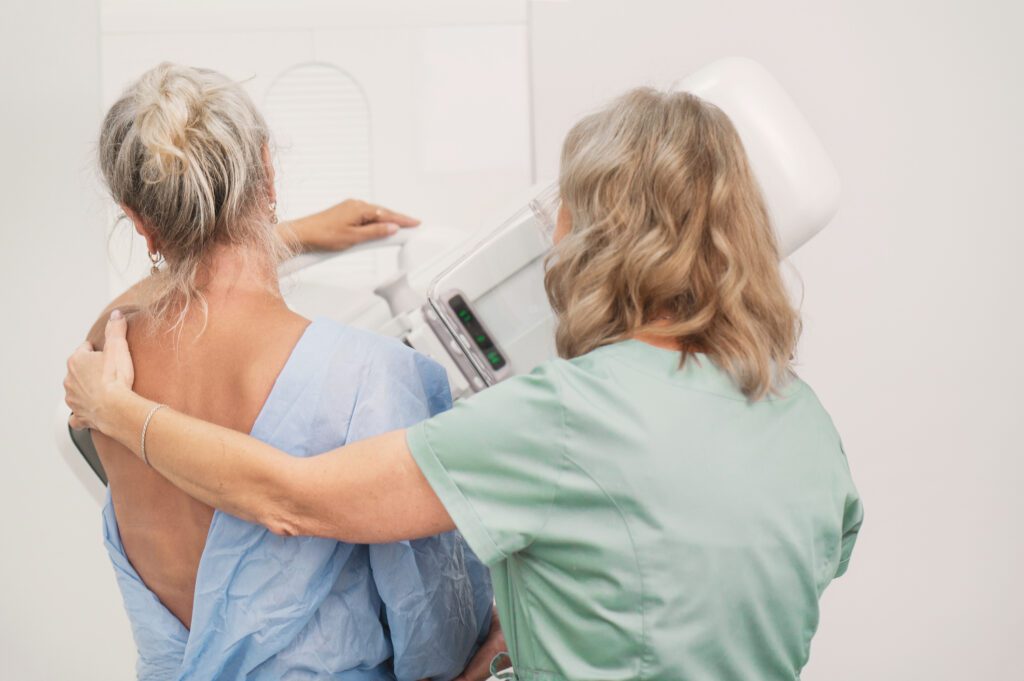
The barriers that prevent people with mobility disabilities from receiving cancer screenings are well documented and deeply frustrating:
Mammography equipment that requires standing. Traditional mammography machines are designed for patients who stand upright. Many women who use wheelchairs, scooters, or who have limited standing ability are told — incorrectly — that a mammogram simply isn’t possible for them.
Exam tables that don’t lower. For colonoscopies, Pap smears, skin checks, and clinical breast exams, the exam table itself is the obstacle. Standard tables sit at a fixed height that makes independent transfer impossible for many patients and difficult even with assistance.
Inaccessible changing areas. Gowns, lockers, and dressing rooms are rarely designed for wheelchair users, making the pre-screening process needlessly complicated and undignified.
Transportation challenges. Getting to and from a screening appointment can be a significant logistical challenge for people who use accessible transit or rely on paratransit services with limited scheduling windows.
Communication barriers. Patients who are Deaf, hard of hearing, or who have speech disabilities often face facilities without interpreters or accessible communication technology, creating a separate layer of exclusion.
What the ADA Requires
Here is something every person with a disability and every healthcare provider needs to know: accessible medical care is not optional — it is the law.
Under Title III of the Americans with Disabilities Act (ADA), medical facilities are required to provide equal access to their services. This includes ensuring that equipment and facilities are accessible to people with disabilities. The ADA National Network (adata.org) clarifies that healthcare providers must make reasonable modifications to policies, practices, and procedures, and must provide accessible equipment when needed.
Section 504 of the Rehabilitation Act extends these protections to any facility receiving federal funding — which includes most hospitals, clinics, and practices that accept Medicare or Medicaid. The HHS Office for Civil Rights (hhs.gov/ocr) enforces both the ADA and Section 504 in healthcare settings and accepts complaints when patients are denied accessible care.
If a facility tells you that mammography or any other screening is impossible because of your disability, ask specifically about accessible equipment and accommodations. If none are available and none are offered, that facility may be out of compliance with federal law.
“Healthcare providers are obligated under the ADA to provide accessible medical equipment and make reasonable modifications to serve patients with disabilities equally.” — ADA NATIONAL NETWORK
What Accessible Mammography Looks Like
Accessible mammography does exist — and when properly equipped facilities provide it, patients with mobility disabilities can receive the same quality screening as anyone else.
Height-adjustable mammography equipment allows the machine to be positioned for a patient who is seated in a wheelchair or on a transfer bench. Some units can accommodate patients who cannot stand at all. Staff training is equally critical: technologists trained in positioning techniques for patients with disabilities can make the difference between a completed exam and a missed screening. The American College of Radiology (acr.org) provides guidance on accessible mammography positioning and facility standards.
When calling to schedule a mammogram, ask the facility directly:
- Do you have height-adjustable mammography equipment?
- Can you perform a seated mammogram for a person who uses a wheelchair?
- Do you have an accessible changing room?
- What is your process for assisting with transfers if needed?
If the facility cannot answer these questions clearly or confidently, consider contacting a larger hospital system, an academic medical center, or a federally qualified health center, which are often better equipped and staffed for accessible care.
Beyond Mammograms: Other Screenings and Their Challenges

Breast cancer screening is the focus of October, but disability-related access barriers affect the full range of recommended cancer screenings:
Colonoscopies require transfer to a procedure table and sedation, which creates coordination challenges around positioning and monitoring. Facilities with ceiling-mounted lifts or trained transfer teams can manage this safely.
Pap smears and gynecological exams often depend on exam tables that don’t lower and stirrups that don’t adjust. Accessible gynecological chairs and flexible positioning techniques are available and should be requested.
Skin cancer checks require visual access to the full body, which may require assistance with positioning or clothing removal. Communicating your needs clearly before the appointment allows the care team to prepare appropriately.
For each of these screenings, the approach is the same: call ahead, ask specific questions about accessibility, and request accommodations in writing when possible.
Requesting Accommodations: A Step-by-Step Approach
You do not have to wait until you arrive at the facility to encounter a problem. Proactive communication before your appointment gives the care team time to prepare:
- Call the facility’s accessibility coordinator or patient services department — not just the scheduling line — and explain your mobility needs specifically.
- Request accessible equipment and transfer assistance in writing, such as through a patient portal message or follow-up email, so there is a record of your request.
- Ask about parking and facility access: Is the accessible entrance clearly marked? Is the imaging department on an accessible floor?
- Request an interpreter or communication support at the time of scheduling if you are Deaf or hard of hearing.
- Know who to call if something goes wrong: The ADA National Network (1-800-949-4232) provides free guidance on disability rights in healthcare settings.
Telehealth: A Complement, Not a Replacement

Telehealth has expanded access to healthcare consultation for many people with disabilities, reducing transportation barriers and allowing for care from home. However, telehealth cannot replace the physical component of cancer screenings — mammograms, Pap smears, colonoscopies, and skin checks all require in-person examination.
Telehealth can play a valuable supporting role: discussing screening results, reviewing medical history, getting referrals to accessible facilities, and following up on treatment. Use it as a bridge, not a bypass.
Your Rights as a Patient
You have the right to equal access to medical care. If a facility refuses to provide accessible equipment, fails to offer reasonable modifications, or turns you away because of your disability, you can:
- File a complaint with the HHS Office for Civil Rights at hhs.gov/ocr
- Contact the ADA National Network for guidance and referrals
- Consult with a disability rights attorney
No one should miss a life-saving screening because a facility failed to plan for the full range of human bodies. This October, take one step: call a facility, ask about accessible mammography, and schedule your screening. Your life is worth advocating for.
Know Before You Go: Questions to Ask When Scheduling a Cancer Screening
Before your appointment, call the facility and ask:
- Do you have height-adjustable mammography equipment?
- Can you perform a seated mammogram?
- Is the changing area wheelchair accessible?
- Do you have an accessible exam table that lowers?
- Can you provide transfer assistance?
- Is there a sign language interpreter available?
ADA National Network: adata.org | 1-800-949-4232 (free, confidential guidance on disability rights in healthcare)
Don’t let inaccessible equipment stand between you and a life-saving screening. Take these steps:
- Schedule your mammogram or cancer screening today — ask about accessible equipment when you call.
- Share this article with someone in your community who might benefit.
- Know your rights: visit adata.org or call 1-800-949-4232 for free guidance on ADA protections in healthcare.
