


The holidays are a season of warmth, light, and cherished rituals — the quiet satisfaction of hanging a favorite ornament, the glow of candles in a window, the smell of pine and cinnamon filling a room. But for people living with limited mobility, vision loss, or other physical disabilities, the standard advice — drag out the boxes, climb the ladder, string the lights, top the tree — can quietly exclude the very people who most deserve to celebrate.
That exclusion is not inevitable. With a few thoughtful adjustments to how we think about holiday decorating, every person — regardless of physical ability — can participate fully in the magic of the season. The goal is not to simplify or diminish; it is to design for joy that is genuinely accessible. This guide offers practical, specific, and empowering ideas for people with limited mobility or vision, as well as the families and caregivers who celebrate alongside them.
The Scale of the Need: Disability and Home Life in America
Holiday decorating is a home activity — and home life is precisely where disability intersects most directly with daily lived experience. According to the CDC’s 2024 disability data release, more than 70 million U.S. adults — more than 1 in 4 — reported living with some form of disability in 2022, the highest figure ever recorded. Mobility limitations are the single most common disability type, affecting approximately 13.7% of adults, according to Census Bureau data compiled by Disabled World.
Vision difficulty affects millions more. The American Foundation for the Blind (AFB), drawing on the 2024 American Community Survey, estimates that roughly 7 million Americans report significant vision difficulty, while a broader National Health Interview Survey cited by AFB estimates that approximately 49.5 million American adults report some degree of difficulty seeing.
These are not edge cases. They are family members, neighbors, and community members who deserve a holiday season that works for them — not around them.
The Real Barriers: Why Standard Holiday Decorating Can Fall Short
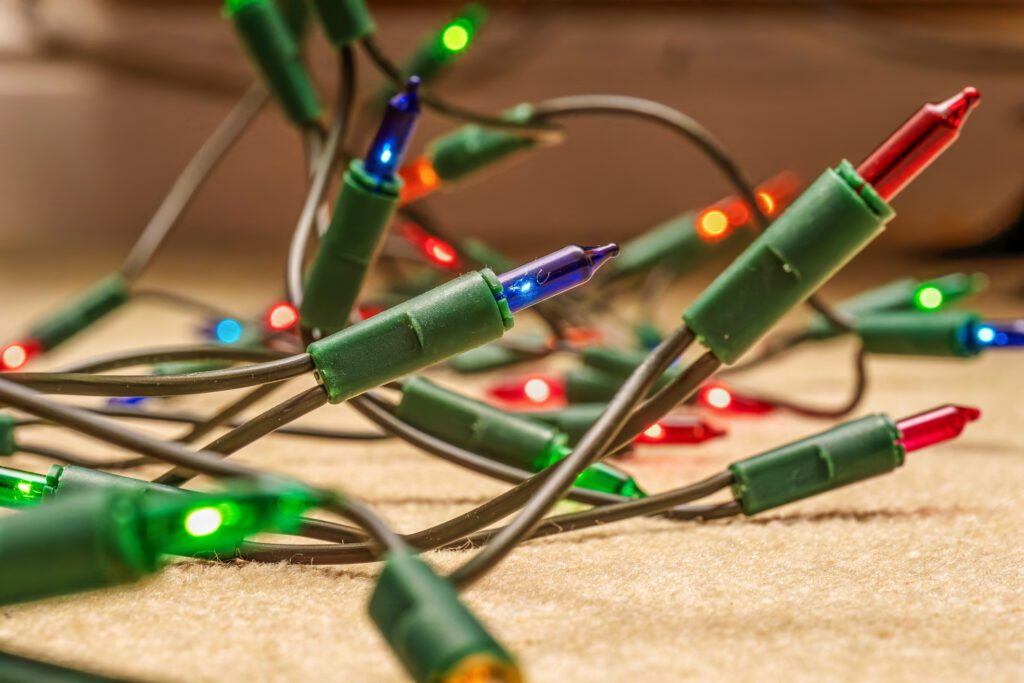
Most holiday decorating advice assumes able-bodied access: the ability to lift heavy boxes, climb ladders, work at standing height, sort small items by sight, and navigate cluttered spaces without risk. For people with physical disabilities, these assumptions can turn a joyful activity into a frustrating — or even dangerous — one.
Common barriers include:
- Reach limitations. Standard tree heights, mantle decorations, and ceiling-hung items are often out of range for people who use wheelchairs or have limited upper-body mobility. The American Occupational Therapy Association notes that comfortable reaching height for a seated wheelchair user is typically between 15 and 48 inches, far below the top of a standard six-foot tree.
- Weight and grip challenges. Heavy storage boxes, tangled light strings, and small ornament hooks can be difficult or painful for people with arthritis, reduced hand strength, or upper extremity disabilities.
- Visual inaccessibility. Standard holiday decor is designed almost entirely around sight — colors, sparkle, and visual depth. People who are blind or have low vision are often left as passive observers rather than active participants in decorating.
- Safety hazards in the home environment. Excess cords, small breakable ornaments, floor-level decorations, and cluttered pathways can create serious fall and navigation risks for people using mobility aids.
Understanding these barriers is the first step to designing around them thoughtfully.
Practical Decorating Ideas That Work for Everyone

Good accessible design is not about doing less — it is about doing things smarter. The following strategies allow people with limited mobility or vision to decorate independently, creatively, and with pride.
Scale the Tree to the Person
A tabletop or countertop Christmas tree — typically 18 to 36 inches tall — placed on a sturdy surface at wheelchair-seat height transforms the entire decorating experience. Rather than straining upward to place ornaments, a person who uses a wheelchair can decorate at eye level and arm’s length, with full control and participation. Many pre-lit tabletop trees are available at mass retailers for under $40, eliminating the separate task of stringing lights entirely.
For those who prefer a full-sized tree, consider a pre-lit artificial tree with built-in LED lighting. This removes one of the most physically demanding decorating tasks — untangling and stringing lights — while also eliminating a tripping hazard from loose cord.
Embrace Smart Lighting and Voice-Controlled Decor
Voice-activated smart home devices (Amazon Echo, Google Nest, Apple HomePod) integrate with smart plugs and smart bulbs, allowing a person to turn holiday lights on and off, dim them, or change their color using only voice commands. This is particularly valuable for people with mobility limitations who cannot easily reach a wall switch or power strip.
Automatic outlet timers — available for a few dollars at any hardware store — can keep lights on a consistent schedule without manual operation. Battery-operated flameless LED candles with remote controls bring holiday ambiance without any cord management or fire risk.
Keep Pathways Clear and Plan Your Layout
Before placing any decoration, walk (or roll) through every pathway in the room. Any item that reduces a hallway or doorway to less than 36 inches of clear passage creates an accessibility barrier. Floor-level decorations — including wrapped gifts, decorative logs, and door mats — should be consolidated to one clearly defined zone rather than scattered.
This is not just about convenience. For people who use walkers, canes, or wheelchairs, an obstructed path can mean a fall, a bruised wheel, or simply the humiliation of being unable to move freely through one’s own home.
Products, Tools, and Organizations That Can Help
A growing range of adaptive tools and assistive products makes accessible holiday decorating genuinely achievable.
- Reacher-grabber tools allow a person who uses a wheelchair to place and retrieve ornaments, hang garlands at higher points, or pick up dropped items without bending or stretching dangerously. Products like the Vive Health Reacher Grabber (available at major retailers) offer ergonomic grip handles that reduce hand strain.
- Light-hanging poles — such as the No Ladder Pro Max Hanging Pole, available at Lowe’s — extend to 11 feet and allow a person to hang outdoor lights or high indoor garlands from a seated or standing position, with no ladder required.
- Rolling carts or utility trolleys allow someone to transport decoration boxes, supplies, and ornaments from room to room without carrying weight on their body, which can be difficult for people with chronic pain, fatigue, or limited upper-body strength.
Key organizations with accessible holiday resources:
- Numotion’s ProTips Holiday Guide — practical advice for wheelchair users during the holidays
- Massachusetts Association for the Blind and Visually Impaired (MABVI) — holiday inclusion tips for people who are blind or have low vision
- Paths to Literacy — tactile holiday decoration ideas adaptable for adults
- The Mighty — community-sourced tips from people with disabilities and chronic illness
Tips by Disability Type: Vision, Mobility, and More

For People Who Are Blind or Have Low Vision
The goal is to shift holiday decor from a purely visual experience to a multi-sensory one — one that can be experienced and enjoyed through touch, scent, sound, and remaining vision.
- High-contrast color palettes help people with low vision perceive decorations more clearly. Dark ornaments on a light background (or vice versa) are far more visible than green ornaments on a green tree. Try pairing deep burgundy or metallic gold against a cream or white background.
- Tactile ornaments with varied textures — smooth glass balls, rough pinecones, soft velvet ribbons, jingle bells — allow a person to explore and “read” the tree by touch. Assign specific textures to specific types of ornaments to create a tactile map.
- Scent-led decor is powerfully evocative and fully accessible. Clove-studded oranges, cinnamon bundles, fresh pine boughs, and scented candles (flameless for safety) all build a holiday atmosphere through smell, independent of sight.
- Auditory elements — a small bell wind chime near the door, a tabletop music box, or a Bluetooth speaker on a timer playing holiday music — add another layer of sensory richness.
- The Low Vision-Friendly Christmas Display guide from MABVI recommends a dark tablecloth against light walls or flooring to define spaces and help orient a person with low vision when navigating the room.
For People with Limited Mobility or Who Use Wheelchairs
- Decorate at seated height. Place the most beloved, most detailed decorations where they can be seen and touched from a seated position — not just at standing eye level.
- Use Command Strips and adhesive hooks rather than nails or pins to hang decorations at any height without tools or climbing.
- Delegate the high stuff. A person who uses a wheelchair can serve as the decorator-in-chief — directing placement, selecting items, arranging tablescapes — while a family member or caregiver handles the physically out-of-reach tasks. This is not accommodation; it is collaboration.
- Weighted and stable bases for any floor-level item prevent tipping, which is both a safety concern and a source of frustration for wheelchair users navigating close to furniture.
For People with Arthritis or Limited Hand Dexterity
- Choose large ornament hooks (wide-gauge wire loops) over thin metal hooks that require fine pinching.
- Clip-on ornaments eliminate hooks entirely.
- Pre-made garland in longer sections means fewer individual pieces to handle.
- Ergonomic scissors and wire cutters are available through occupational therapy supply retailers.
Budget-Friendly and DIY Accessible Decorating

Accessible decorating does not require expensive specialized products. Many of the most effective approaches cost little or nothing.
DIY tactile ornaments for under $10: According to Paths to Literacy’s tactile holiday decoration guide, simple ornaments can be made from materials like metal cookie cutters, ribbon, yarn, pine cones, and sandpaper cutouts — all sorted by texture and hung in a deliberate sequence on the tree. These cost nearly nothing and involve the whole family in the making.
Free tools already in your home: – A broom handle or mop stick can extend reach for hanging garland at higher points. – A lazy Susan (a rotating kitchen tray) allows a person with limited reach to access a full 360° of a table centerpiece or wreath without moving. – A strip of Velcro applied to table edges can hold a tablecloth in place, keeping it from being pulled off by an accidental grab.
Dollar store finds that work well: – Battery-operated tea lights and candles are widely available for under $5 for a pack of 12. – Large, shatterproof ball ornaments in bold colors are ideal for high-contrast tree decorating and are available at dollar stores seasonally. – Sensory-safe ribbon in multiple textures (velvet, metallic, satin) is inexpensive and can be used to create tactile tree sections.
Free resources: The RNIB’s Joy Makers Guide to Christmas is a free downloadable PDF packed with sensory decoration instructions and holiday activity ideas specifically designed for people who are blind or have low vision.
Your home is your sanctuary — and the holidays are yours to claim. Whether you’re decorating for the first time with a new disability, adapting a beloved tradition to fit changing mobility, or helping a family member create a home that works for them, the ideas in this article are a starting point, not a ceiling. We want to hear your strategies: What accessible decorating hacks have worked in your home? Share your ideas and connect with us on social media. And if you found this article helpful, share it with someone who could use a little holiday inspiration this season.
If You Liked This Article, You May Also Like
- Best Adaptive Home Products of 2026 — Our annual roundup of the most innovative adaptive tools and home products for people with disabilities
- Federal Policy and Americans with Disabilities in 2026: What Has Changed, What Is at Stake, and What the Data Show — A comprehensive look at the policy landscape affecting people with disabilities
- Resources for Individuals and Employers to Combat Disability Discrimination — Know your rights and find support for disability-related challenges in the workplace and beyond
