


When the Today show’s Vicky Nguyen reported on senior women “tapping into their inner Golden Girl to save money,” the segment struck a nerve. Viewers recognized something they were already thinking about — or doing. What once seemed like a sitcom premise has become one of the most practical solutions to two of the biggest challenges facing older Americans today: housing they can’t afford and isolation that threatens their health.
Now, research is catching up to what thousands of older adults already know from experience. And for seniors with disabilities, the case for shared housing goes beyond the budget — it goes to the heart of what makes independent living possible.
Nearly a Million Seniors Already Live This Way
The “Golden Girls” model has a name now, but it’s been growing for years. According to Harvard’s Joint Center for Housing Studies, approximately 990,000 older U.S. adults lived with unrelated housemates or roommates in 2023 — more than double the number from two decades ago, and up 8.8% in just the two years between 2021 and 2023. Seniors now make up about three in ten of all house-sharing households nationwide.
The interest is even higher than the action. A 2024 AARP survey of 3,000 U.S. adults found that 57% of women age 50 and older would consider living with a friend as they age (AARP, “Could You Really Live Like the ‘Golden Girls’?”). About 4 million women over 50 already live in households with at least two other women over 50 — the real-life Golden Girls arrangement, happening quietly all across the country.
Why Now? The Financial Picture for Older Women
For older women on fixed incomes, the math is stark. About one-third of households headed by someone 65 or older are cost-burdened, spending 30% or more of their income on housing and utilities, according to Harvard’s Joint Center for Housing Studies. Women receive smaller Social Security checks than men on average, and they live longer — so every dollar must stretch further.
Nearly 3 million women over 65 live in poverty — double the number of men — and nearly half of elderly unmarried women, including widows, depend on Social Security for 90% or more of their income (Social Security Administration data, cited by Eskaton).
A housemate changes that math directly. HomeShare Online, the leading senior-focused homesharing platform, reported that homeowners in its network received an average of $825 per month in rental income — roughly $10,000 per year in additional income that can make the difference between housing stability and crisis.
The Health Case: Isolation Is Not Just Uncomfortable — It Is Dangerous
The financial argument is only half the story. In May 2023, U.S. Surgeon General Dr. Vivek Murthy issued a landmark advisory declaring loneliness and isolation a public health epidemic, finding that social disconnection raises the risk of premature death by nearly 30% — comparable to smoking up to 15 cigarettes a day.
For older adults specifically, the Centers for Disease Control and Prevention documents a 50% increased risk of dementia from social isolation, a 29% increased risk of heart disease, and a 32% increased risk of stroke. Roughly 16.2 million older adults — 28% of community-dwelling seniors — lived alone in 2023, with the rate climbing to 42% among women 75 and older (Administration for Community Living, Profile of Older Americans 2023).
A housemate doesn’t just reduce loneliness — it structurally eliminates the kind of objective daily isolation that research most strongly links to cardiovascular and cognitive risk. A program participant in Vermont put it plainly: she couldn’t have stayed in her home without her homesharer.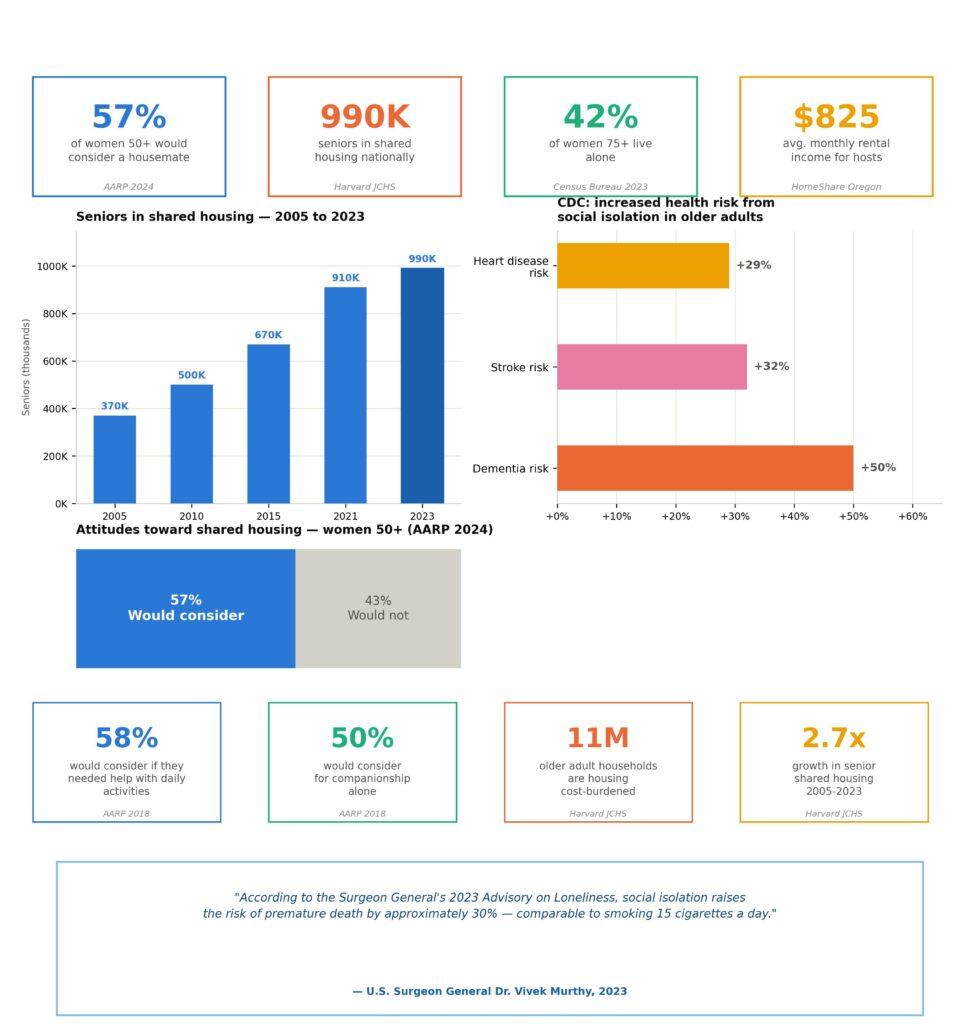
What This Means for Older Adults with Disabilities
For an older adult with a mobility limitation, chronic pain, or early cognitive changes, a housemate provides something formal care systems often cannot: someone who is simply there. A housemate can notice when something seems off, call for help in an emergency, carry groceries, and offer the kind of spontaneous daily support that keeps small problems from becoming crises.
Shared housing also makes the physical environment of aging in place more financially achievable. Home accessibility modifications — grab bars, widened doorways, ramps, accessible bathroom conversions — typically cost $5,000 to $20,000 for targeted improvements. In a shared home, those costs can be divided between two people who both benefit. A ramp installed for one person serves both over time.
The USDA Rural Housing Repair and Rehabilitation program provides grants up to $10,000 to homeowners age 62 and older in eligible rural areas specifically for accessibility modifications — a resource that pairs naturally with a shared housing arrangement. An occupational therapist or certified aging-in-place specialist (CAPS) assessment, typically $200–$500, is recommended before making modifications.
It’s important to be clear about what shared housing is not: it is not a substitute for formal in-home care for people with significant support needs. U.S. homeshare programs explicitly separate housing companionship from personal care. A housemate is not a trained aide. The strongest arrangements work alongside — not instead of — formal care services.
Types of Arrangements: Which One Fits Your Situation?
Three main models exist, and they serve different needs.
Informal roommate arrangements offer maximum flexibility. Two or more people who find each other through personal networks or online platforms decide their own terms. This requires the most self-management but costs the least.
For-profit matching platforms like HomeShare Online (homeshareonline.org) bring structure to the process. HomeShare Online, which operates in all 50 states, uses a compatibility algorithm covering dozens of factors — sleep schedules, cleanliness standards, guest policies, pet tolerance, and more — combined with background checks, customizable leases, and rent payment tools. Think of it as a thoughtful matchmaking service specifically designed for people over 50.
Nonprofit homeshare programs go furthest in vetting and ongoing support. Programs like HomeShare Vermont and ElderHelp of San Diego are free to participants, funded through aging services grants, and provide intensive screening including trial periods and follow-up monitoring. The National Shared Housing Resource Center (nationalsharedhousing.org) maintains a national directory of approximately 300 local nonprofit programs — the best starting point for finding a vetted program near you.
For seniors who want intentional community rather than a one-on-one arrangement, the Cohousing Association of the United States (cohousing.org) lists senior co-housing communities where residents own or rent private homes clustered around shared spaces and self-govern as neighbors.
LGBTQ+ older adults have a dedicated resource in SAGE (sageusa.org), the largest U.S. LGBTQ+ elder organization, which maintains a National LGBTQ+ Elder Housing Initiative and a directory of welcoming communities.
Before You Move In: What Every Senior Needs to Know
A written housemate agreement is essential. It should cover expenses, house rules, what happens if one person’s health declines, and clear exit terms with notice periods. This is not a formality — it is what protects both parties.
Benefits can be affected — but a 2024 rule change helps. As of September 30, 2024, the Social Security Administration removed food from In-Kind Support and Maintenance (ISM) calculations for SSI recipients. This means a housemate sharing meals or groceries no longer automatically reduces SSI benefits by up to one-third (Federal Register, March 27, 2024). Regular Social Security retirement benefits are not income-tested and are not affected by living arrangements. However, Medicaid recipients should consult an elder law attorney before moving, since rental income can affect Medicaid eligibility.
Section 8 voucher holders must get written Public Housing Authority approval before a new person moves in — not after.
Homeowners should notify their insurer and check with their county property appraiser about homestead exemption rules before accepting a housemate. Standard homeowner’s insurance typically does not cover rental arrangements.
Compatibility matters as much as finances. Sleep schedules, cleanliness expectations, guest policies, temperature preferences, and values alignment all predict whether an arrangement lasts. A trial period of one to three months before committing to a longer term is widely recommended.
The Choice Belongs to You
Shared housing is not for everyone, and it does not have to be. For many older adults — including those navigating life with a disability — it is an active, deliberate choice to trade solitude for security, to reduce financial pressure, and to build the kind of daily community that supports both health and independence. The infrastructure to make it work exists: matching platforms, nonprofit programs, legal frameworks, and financial assistance tools. The “Golden Girls” had something right: a home shared with the right people is a different kind of home entirely.
Key Resources for Senior Shared Housing
- Find a local homeshare program: National Shared Housing Resource Center — nationalsharedhousing.org
- Online matching platform (50+ focused): HomeShare Online — homeshareonline.org
- Senior co-housing directory: Cohousing Association of the United States — cohousing.org
- LGBTQ+ elder housing resources: SAGE – sageusa.org
- Home accessibility grants (rural, 62+): USDA Rural Housing Repair — up to $10,00 in grants; contact your local USDA Rural Development office
- Benefits counseling: Contact your local Area Agency on Aging (find yours at eldercare.acl.gov or call 1-800-677-1116)
- Fair housing complaints: HUD — 1-800-669-9777
Did You Know? As of September 30, 2024, a new SSA rule means that an SSI recipient sharing groceries or meals with a housemate no longer automatically loses up to one-third of their monthly benefit. If you or someone you know on SSI has avoided shared housing because of this concern, the rules have changed.
Ready to explore shared housing? Start with the National Shared Housing Resource Center at nationalsharedhousing.org to find a vetted nonprofit program near you — most are free to participants. If you prefer a self-directed approach, HomeShare Online (homeshareonline.org) offers compatibility matching with background checks and lease tools in all 50 states.
Before you move forward, contact your local Area Agency on Aging (1-800-677-1116 or eldercare.acl.gov) for free benefits counseling — especially if you receive SSI, Medicaid, or a housing voucher. And consult an elder law attorney (find one at naela.org) before signing any agreement.
Share this article with someone who might be ready to find their Golden Girls.
