

At ten years old, Emily Ladau sang with Elmo, met Oscar the Grouch, and kept one of Big Bird’s feathers as a memento. Her character on Sesame Street was a girl who moved into the neighborhood, used a wheelchair, and showed millions of children that disability is a natural part of life — not a problem to be fixed. That early experience didn’t just make for a great story. It planted the seed for a career that has grown into one of the most influential disability advocacy voices in America. Now, twenty-five years later, Ladau is back with an updated edition of her landmark book, a national book tour, and an urgent message: the disability rights movement cannot afford to stand still.
Who Is Emily Ladau?
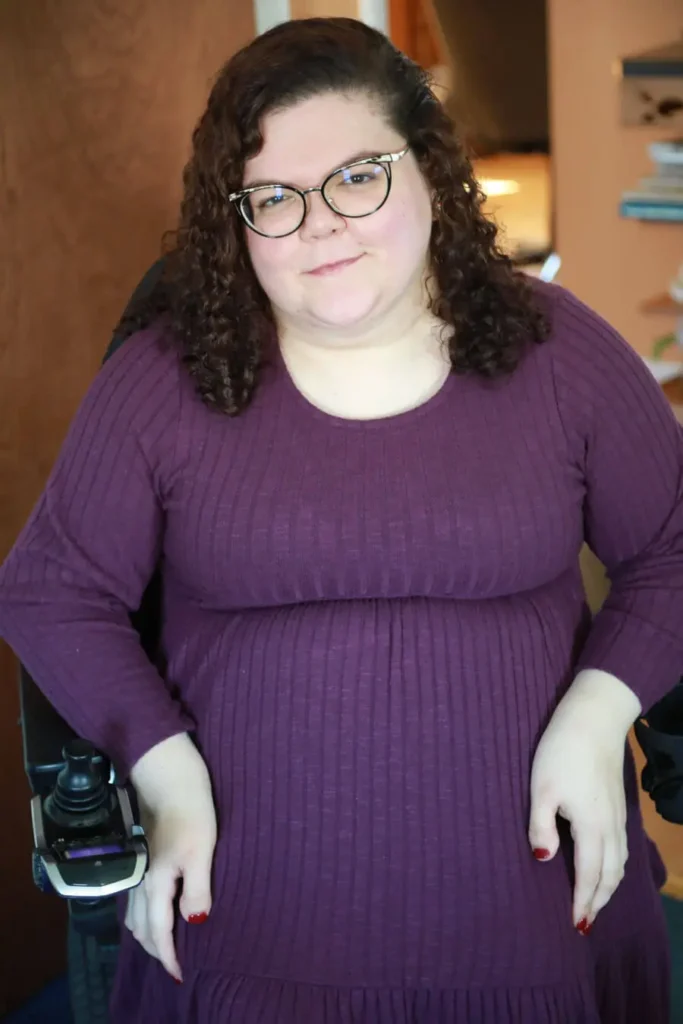
Emily Ladau is a disabled writer, speaker, podcaster, cultural access consultant, and the author of Demystifying Disability: What to Know, What to Say, and How to Be an Ally (Ten Speed Press / Penguin Random House). She is co-host of The Accessible Stall Podcast, author of the Substack newsletter Words I Wheel By, and a recognized leader whose clients range from Microsoft and Netflix to the United Nations and the U.S. Department of Education. In October 2026, during Disability History Month, she is on a national book tour for the newly revised and expanded edition of her best-selling guide — an update she describes as more urgent than ever.
Background and Early Life
Emily Ladau was born in 1991 on Long Island, New York — the same year the Americans with Disabilities Act celebrated its first birthday. She has Larsen syndrome, a genetic joint and muscle disorder that she shares with her mother. She uses a wheelchair and has described her disability as “a natural state of being”: it has been present her entire life, not an interruption of it.
As a child, she was often the only student with a visible disability in her elementary school. “I’d often shy away from talking about my disability,” she has written in The Meteor, “and the biggest compliment you could pay me was that you didn’t think of me as disabled.” That early experience of performing normalcy — of shrinking — became the foundation for the opposite trajectory her life would take.
The turning point came at age ten, when a talent manager connected her with Sesame Street through a camp for children with disabilities. She auditioned, got a callback, and won a recurring role. Her character, also named Emily, moved into the neighborhood using a wheelchair and leg braces. She appeared in approximately seven episodes over one season, estimated Season 33, early 2002, singing with Elmo and meeting the show’s beloved cast. “Hanging out with Big Bird, Elmo, and Oscar the Grouch was a whole lot of fun,” she later wrote, “but the best part was beginning to find my voice as an advocate. The experience of educating about disability on a national platform showed me the power of storytelling and communicating as a way to break down stigma and debunk stereotypes.”
Emily Ladau’s Notable Work in Disability Communications and Advocacy
After earning a Bachelor of Arts in English from Adelphi University (Garden City, NY) in 2013, Ladau arrived in Washington, D.C. to complete an internship with the American Association of People with Disabilities (AAPD). It was transformative. “In finding the disability community,” she has said, “I began to find myself.”
That moment marked her shift from someone who had lived disability privately to someone who would make disability legible publicly. Her career since has spanned digital communications strategy, editorial leadership (including as founding Editor in Chief of the Rooted in Rights Blog from 2016 to 2022), and cultural access consulting for institutions such as the Brooklyn Academy of Music, the Ronald O. Perelman Performing Arts Center, and Friends of the High Line. She co-founded The Accessible Stall Podcast with Kyle Khachadurian and has been a contributor to The New York Times, The Washington Post, CNN, Vice, HuffPost, SELF, Salon, The Daily Beast, and U.S. News & World Report. She has served on Adelphi University’s Board of Trustees and currently sits on the Board of Directors of Disability Rights Advocates (DRA). In December 2025, she testified before the U.S. Senate Special Committee on Aging, citing that more than one in four U.S. adults live with a disability.
Demystifying Disability — The Book
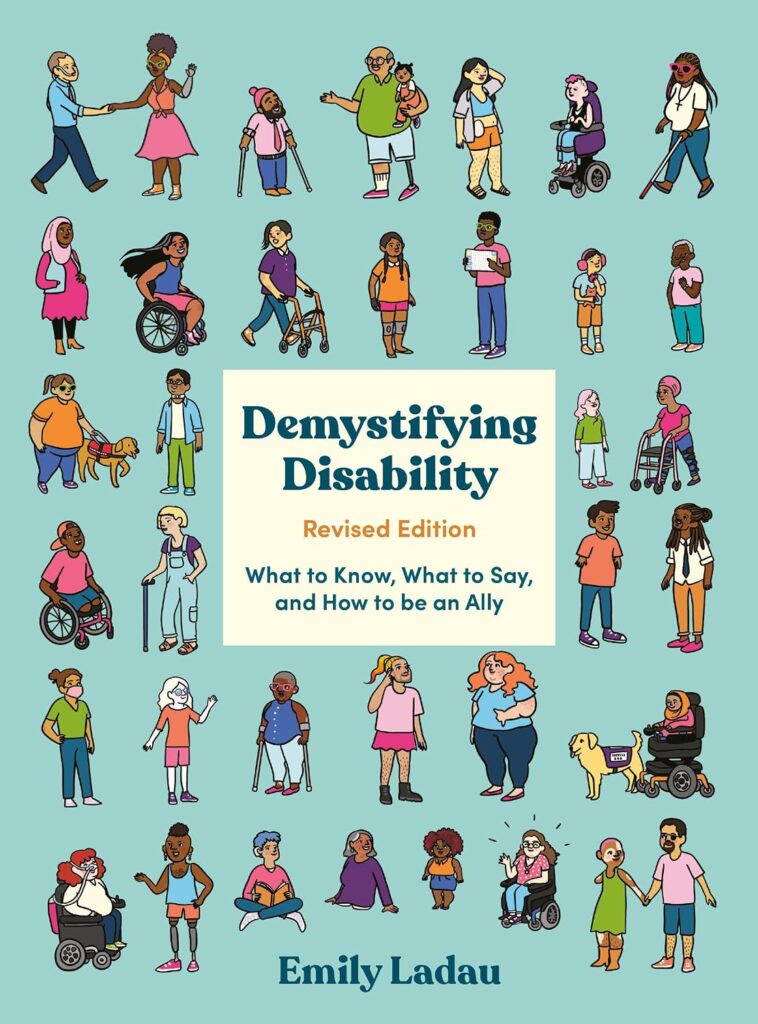
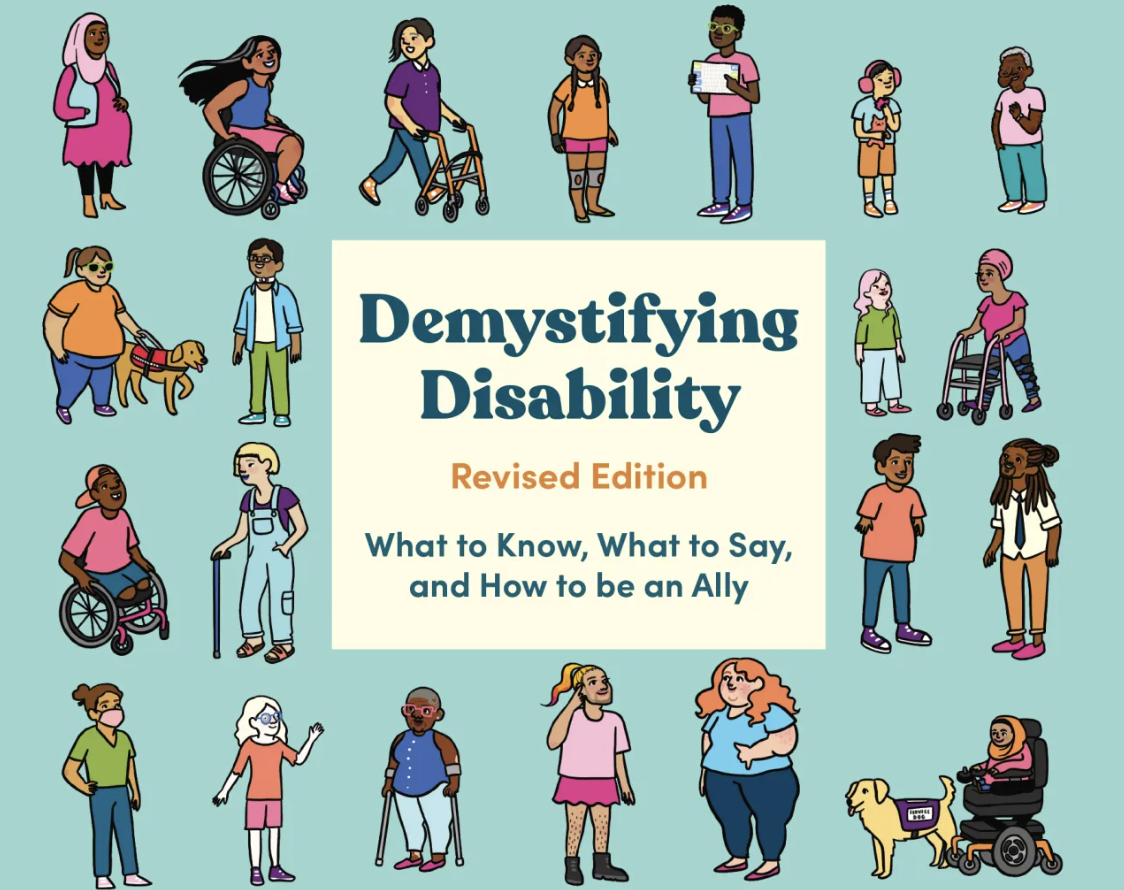
Published in September 2021 by Ten Speed Press (an imprint of Penguin Random House), Demystifying Disability: What to Know, What to Say, and How to Be an Ally is organized into six accessible parts covering: what disability is; disability as part of a whole person; disability history; ableism and accessibility; disability etiquette; and disability stereotypes in media. Written with warmth and precision, the book opens with a grounding fact — disabled people are the world’s largest minority — and builds from there into a practical, intersectional guide.
The book is notable for centering lived experience without sacrificing rigor. Ladau’s core argument is that ableism is both attitudinal and structural: “Less than 25 percent of New York City subway stations have elevators. This qualifies as systemic ableism, because the lack of accessibility limits the freedom of disabled people to get around.” The book teaches readers to name that gap — and to change it.
Endorsements came from across the disability community and beyond. The late Judy Heumann, a foundational figure in the disability rights movement and subject of the Netflix documentary Crip Camp, called Ladau “a wise spirit who thinks deeply and writes exquisitely.” Human rights lawyer and deafblind advocate Haben Girma wrote: “I highly recommend this book to readers seeking to deepen their understanding of disability and ableism.” Journalist Liz Plank called Ladau “a once in a generation kind of writer and activist whose legacy can’t even be quantified.”
Book Riot said it was “a goldmine” for allies. BookPage called Ladau “a responsible guide and advocate for change.” The book is available in paperback ($18.99, ISBN 9781984858979), large print, ebook, and audiobook, and through public libraries via Overdrive/Libby.
The 2026 Revised and Expanded Edition
Five years after its initial release, Demystifying Disability returns with a revised and expanded edition — updated for a world that has changed, and not always for the better. The new edition includes a fresh preface from Ladau, updated statistics reflecting current disability prevalence data, and new sections addressing post-pandemic etiquette: the disability community’s ongoing needs around remote access, masking, and accessible event design that the broader public has largely forgotten.
Most urgently, the revised edition includes coverage of policy changes made by the Trump administration affecting disability rights — cuts, rollbacks, and restructuring that Ladau has described plainly: disability and civil rights, she said in a statement tied to her appointment to the Disability Rights Advocates board, are “being rolled further back every single week.”
The revised audiobook edition, read by Ladau herself, was released September 29, 2026 (runtime: 5 hours 27 minutes). A large print edition was released July 1, 2025.
Key Themes and Takeaways
Demystifying Disability advances several ideas that are especially relevant during Disability History Month:
Language matters — and it is not fixed. Ladau prefers identity-first language — “disabled person” rather than “person with a disability” — viewing it as an acknowledgment that disability is part of identity, not a secondary characteristic to be placed at a distance. At the same time, she respects each disabled person’s right to choose their own terminology. She cautions against euphemisms like “special needs” or “differently abled,” calling them well-intentioned but ultimately distancing.
Ableism is systemic, not just personal. Prejudiced attitudes are one piece of a larger structure. Inaccessible transit systems, inaccessible buildings, and inaccessible media are all ableism — and they require structural remedies.
The disability experience is intersectional. Disability intersects with race, gender, class, religion, and other identities in ways that compound disadvantage. Ladau’s editorial work at Rooted in Rights was explicitly dedicated to “amplifying authentic narratives of the intersectional disability experience.”
Allyship requires action. As Ladau has put it: “if we want the world to be accessible to the disability community, we must make disability accessible to the world.”
Her Advocacy Beyond the Book
Ladau’s advocacy extends well past the page. The Accessible Stall, the podcast she co-hosts with Kyle Khachadurian, tackles disability topics in a conversational format that has built a loyal listener base. Her Substack newsletter, Words I Wheel By (a name her mother coined), publishes weekly and has more than 1,800 subscribers. It covers disability news, representation in media, product reviews from a disability perspective, and personal reflection.
Her speaking clients include Microsoft, NASDAQ, Netflix, Comcast/NBCUniversal, Penn State, the U.S. Department of Education, and the United Nations. She has consulted on cultural access for the Brooklyn Academy of Music, the Perelman Performing Arts Center, Friends of the High Line, and Easterseals Southern California, helping arts institutions think differently about who belongs in their audiences and on their stages.
In April 2025, she delivered the convocation address at Carleton College. In December 2025, she testified before the U.S. Senate. In 2026, she continues to speak and write with the urgency of an advocate who understands that the rights won by the disability rights movement are not guaranteed — they have to be defended.
Recognition and Awards
Ladau’s contributions have been recognized widely:
- 2017: Adelphi University “10 Under 10 Young Alumni” Award
- 2018: Paul G. Hearne Emerging Leader Award, American Association of People with Disabilities (AAPD)
- 2021: Demystifying Disability named a Best Book of the Year by NPR and by Booklist
- 2022: Frieda Zames Advocacy Award, New York City Mayor’s Office for People with Disabilities
- 2022: Henry Viscardi Achievement Award, The Viscardi Center
- 2022: Disability Advocate of the Year, Jewish Federations of North America / Religious Action Center of Reform Judaism
- 2023: Progressive Women’s Voices IMPACT Award, Women’s Media Center
What the Disability Community Is Saying
The disability community has embraced Demystifying Disability as a resource that does what its title promises. “A candid, accessible cheat sheet for anyone who wants to thoughtfully join the conversation,” wrote author and disability advocate Rebekah Taussig. Author Eric Garcia (We’re Not Broken) called it “both comprehensive in its scope and easy to understand.” Chris Ulmer of Special Books by Special Kids wrote that “Emily’s writing has helped to reshape my advocacy and will do the same for many others.”
Readers on Goodreads have praised it for “leaving room at the table for nearly everyone” — a book that can meet people where they are, whether they are newly encountering disability as a concept or are disabled themselves and seeking language and frameworks for their own experience.
How This Impacts People with Disabilities
For disabled readers, Demystifying Disability offers something rarer than information: it offers recognition. Seeing disability described as a natural part of human diversity — not as tragedy, not as inspiration, not as something to overcome — matters. It matters for disabled children who do not yet have language for their experience. It matters for disabled adults navigating workplaces, healthcare systems, and public life that were not designed with them in mind.
The 2026 revised edition amplifies this impact at a moment when federal disability rights protections are under pressure. By updating the book with current policy context and post-pandemic realities, Ladau ensures it remains not only a warm introduction to disability culture but also a practical navigation tool for a changing landscape.
Resources and How to Get Involved
- Buy the book: Available in paperback, large print, ebook, and audiobook from Penguin Random House at penguinrandomhouse.com and all major booksellers; ISBN 9781984858979; $18.99 paperback. Also available through public libraries via Overdrive and Libby.
- Subscribe to Words I Wheel By: Ladau’s Substack newsletter at emilyladau.substack.com (free and paid tiers available).
- Listen to The Accessible Stall: Available on major podcast platforms; co-hosted by Emily Ladau and Kyle Khachadurian.
- Learn more about disability rights: American Association of People with Disabilities (aapd.com); Disability Rights Advocates (dralegal.org); Rooted in Rights (rootedinrights.org).
- Invite Emily to speak: Through the Penguin Random House Speakers Bureau (prhspeakers.com), contact agent Kaley Baron.
Upcoming Events
Emily Ladau’s October 2026 book tour includes three accessible in-person events:
October 19, 2026 — Montclair Art Museum, Montclair, NJ Book Talk moderated by Rebecca Cokley, Program Director of the Ford Foundation’s U.S. Disability Rights program and three-time presidential appointee. 6 PM: Meet & Greet ($35 nonmember / $30 MAM member). 7 PM: Book Talk and signing ($15 nonmember / $10 MAM member). Books available through Watchung Booksellers. Live CART captioning provided. Accessibility contact: Celene Ryan (ADA Coordinator), 347-455-1241.
October 29, 2026 — Gibson’s Bookstore, Concord, NH 6:30 PM at 45 S Main St, Concord, NH 03301. Emily Ladau presents the revised edition.
October 30, 2026 — All She Wrote Books at Connexion, Somerville, MA 7–9 PM at Connexion, 149 Broadway, Somerville, MA 02143. Moderated discussion with Meghan Smith, award-winning senior digital producer on the Equity and Justice team at GBH News (Boston’s NPR/PBS station). ASL/CART services available. Admission: $21. Accessibility accommodations: info@allshewrotebooks.com.
Take the Next Step
Emily Ladau has spent more than two decades turning her own lived experience into a resource for millions — and right now, during Disability History Month, her work is more accessible than ever. If her story resonates with you, the best first step is simple: pick up a copy of Demystifying Disability. Whether you are a person with a disability looking to deepen your sense of community and identity, a caregiver seeking to better understand the people you support, or an ally ready to move beyond good intentions, this book was written for you. It is available in paperback, large print, ebook, and audiobook formats — and free through most public libraries via Overdrive and Libby.
If you are near New Jersey, New Hampshire, or Massachusetts, consider attending one of her October 2026 tour events in person. Each event is designed to be accessible, with ASL interpretation, CART captioning, and open Q&A — the kind of environment Ladau herself advocates for in every room she enters. Beyond the book, subscribe to her Words I Wheel By newsletter on Substack, tune into The Accessible Stall podcast, and follow her writing across major publications to stay connected to her ongoing work.
Disability rights are not a niche issue — they are a human issue. When you amplify voices like Emily Ladau’s, share her book with a friend, or simply show up to a book talk and listen, you become part of the movement she has dedicated her life to building. As she has said herself, the disability community is the world’s largest minority, and it is a community that everyone is eligible to join at any point in life. The work of inclusion belongs to all of us.
