Description
Co-teaching — two certified teachers sharing a classroom — can be the most effective inclusion model schools have. It can also break down quickly, usually not because the teachers are incompetent but because the partnership lacks structured communication. Two professionals with different training backgrounds, often different philosophies about behavior and grading, dropped into the same room with little to no shared planning time, expected to teach together seamlessly. Usually they were assigned to each other — they didn’t choose each other. These templates fill the structured-communication gap.
What’s Inside The Co-Teaching Communication Templates
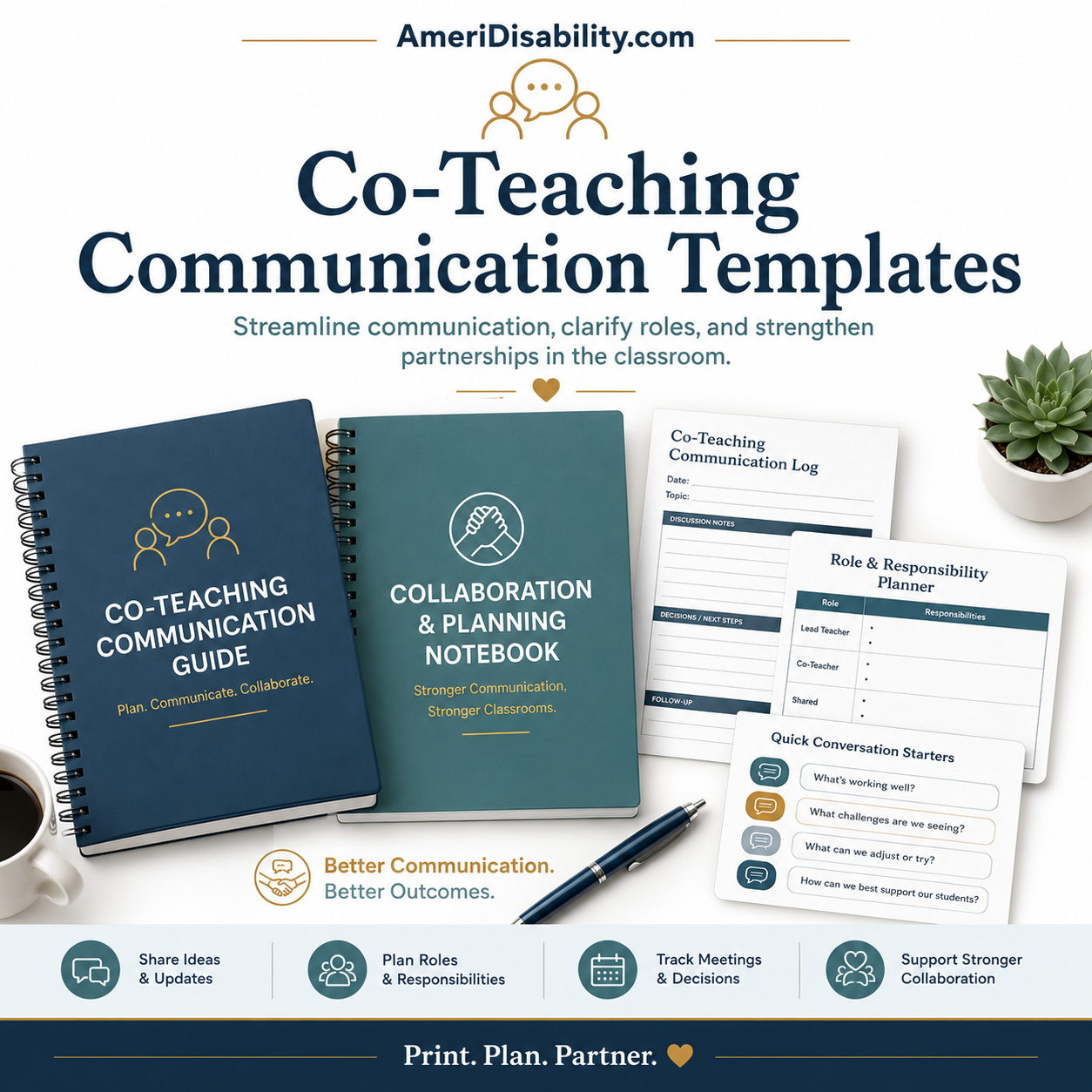
The Co-Teaching Communication Templates are 45 pages organized into 10 sections:
- The six co-teaching models — One Teach/One Observe, One Teach/One Assist, Station Teaching, Parallel Teaching, Alternative Teaching, Team Teaching — with the common pitfall for each
- Initial partnership conversations — 10 questions to discuss before instruction begins, plus specific decisions to make
- Weekly planning templates — three formats: full 45-60 minute planning, quick 15-minute hallway prep, and an asynchronous shared-document version for partnerships with no shared time
- Roles and responsibilities matrix — a fillable 17-row matrix that resolves “who does what” questions
- Behavior coordination protocols — shared discipline approach without identical responses, plus a fillable behavior coordination worksheet
- Family communication templates — joint introduction letter, single-teacher concern email (with co-teacher informed), joint IEP meeting prep
- Grading and assessment coordination — grading coordination conversation, plus accommodations-vs-modifications comparison table
- Difficult conversation scripts — six scripts for the partnership’s hardest moments, including “I feel like I’m becoming an aide” and “We need to talk about how you spoke to a student”
- End-of-semester reflection — individual prep questions plus a shared 6-step reflection protocol
- When the partnership isn’t working — signs to watch for, repair options, when to escalate, when dissolution is appropriate
This Product Is For…
- General education teachers in co-teaching partnerships
- Special education teachers in co-teaching partnerships
- Teaching teams in inclusion classrooms
- Department chairs or instructional leaders supporting co-teaching pairs
- New teachers entering co-teaching partnerships for the first time
- Veteran co-teachers refreshing their practice or improving a struggling partnership
- Administrators designing co-teaching structures at their school
Written For Professional Peers
Both teachers in a co-teaching partnership can use these templates. The general education teacher and the special education teacher are professional peers — each brings different expertise to the same shared work. These templates respect that parity throughout. Language addresses “you and your co-teacher” — never positioning one above the other.
This is different from the paraprofessional dynamic. If you’re working with a paraprofessional (instructional assistant, aide), see Section 7 of the Inclusive Classroom Toolkit for that partnership specifically.
Acknowledges real co-teaching realities
- Many co-teachers were assigned to each other, not chosen
- Many partnerships have no shared planning time
- Different training backgrounds mean different teaching styles
- Grading and behavior philosophies often differ
- Partnerships can break down — and there are options between “keep struggling” and “give up”
The templates work in that reality.
The Bottom Line
Good co-teaching partnerships aren’t accidents. They’re built — through structured conversations, clear roles, and regular reflection. $19 — instant PDF download.