

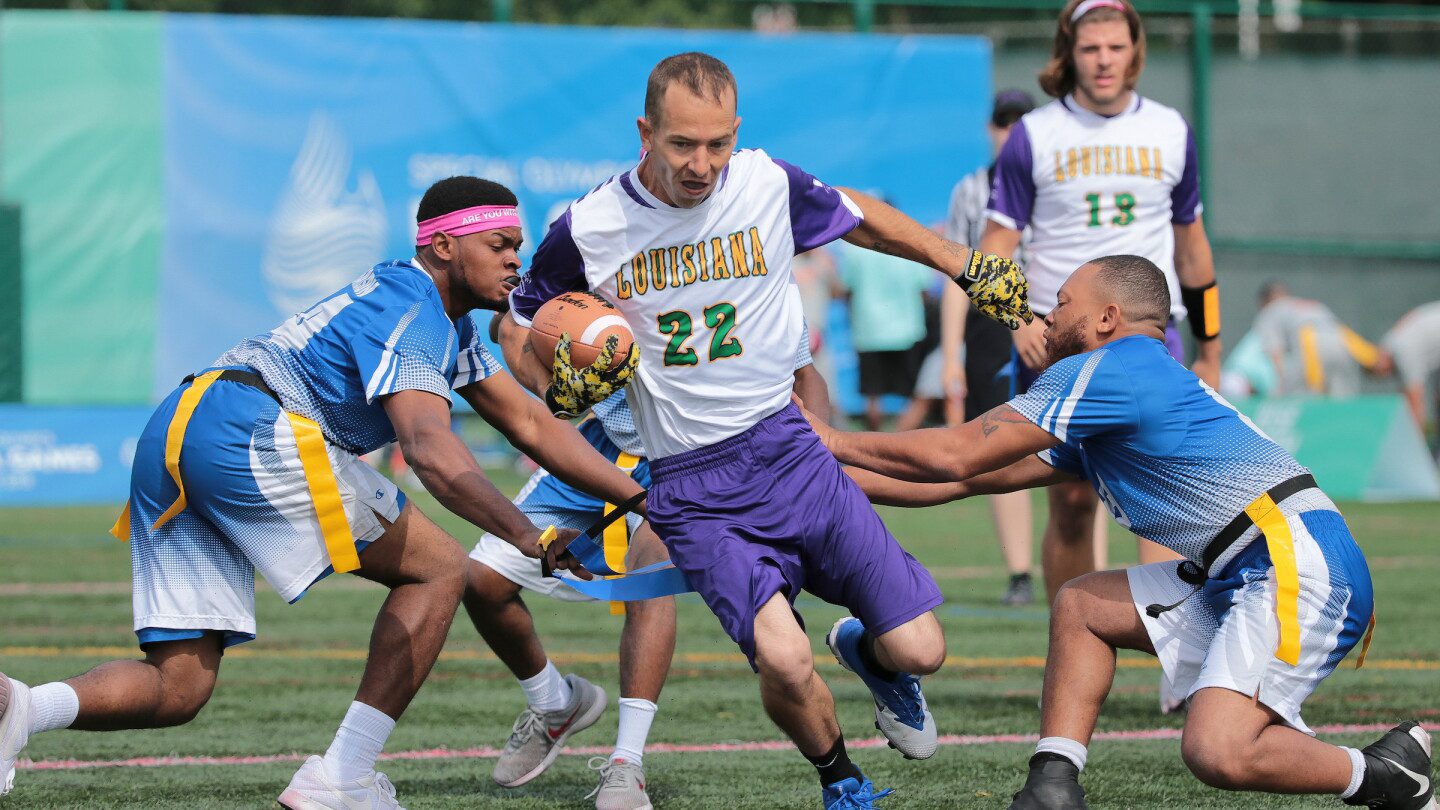
Football is more than a sport. It is a shared language spoken from backyards to stadiums, woven into the rhythms of fall and winter across America. And thanks to a growing movement of adaptive athletes, coaches, veterans, students, and nonprofit organizations, the game now belongs to more people than ever before.
For the more than 61 million Americans living with a disability, adaptive football is no longer a niche experiment — it is an organized, expanding ecosystem with national leagues, youth programs, school-based competitions, and veteran-focused initiatives reaching players in cities from Birmingham to Buffalo to Los Angeles. Whether someone uses a wheelchair, has a limb difference, or has an intellectual disability, there is a version of football designed with them in mind.
This football season, AmeriDisability is taking you inside the world of adaptive football: who is playing, how the game works, the stories that inspire, and exactly how you or someone you love can get on the field.
The Landscape: Four Ways to Play Adaptive Football
Adaptive football in the United States is not a single sport — it is a family of related programs designed for different disabilities, ages, and goals. Understanding which path fits is the first step.
Wheelchair Football
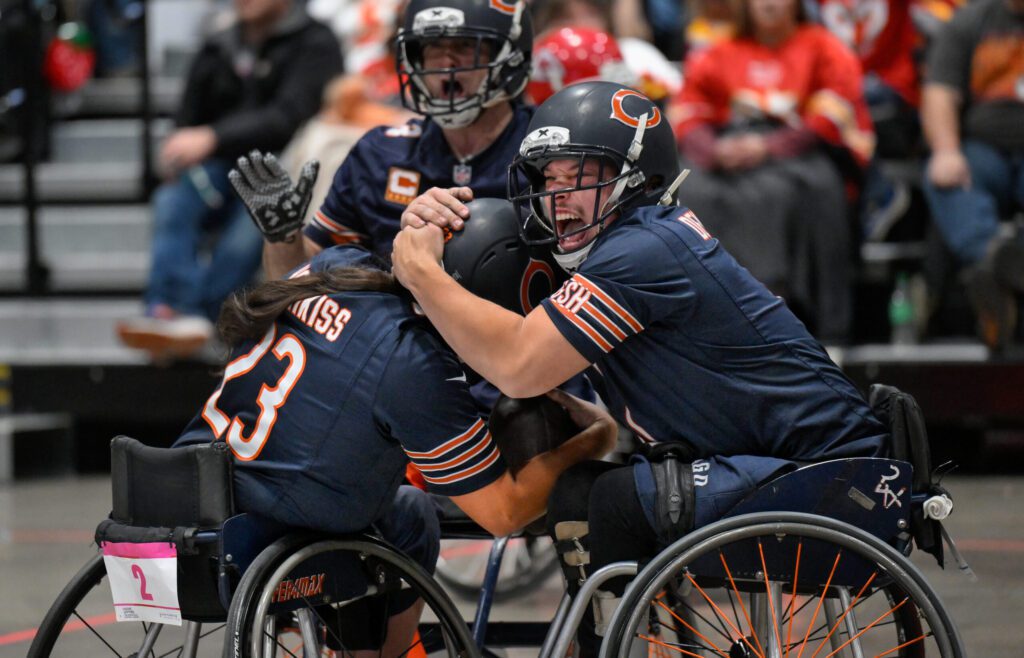
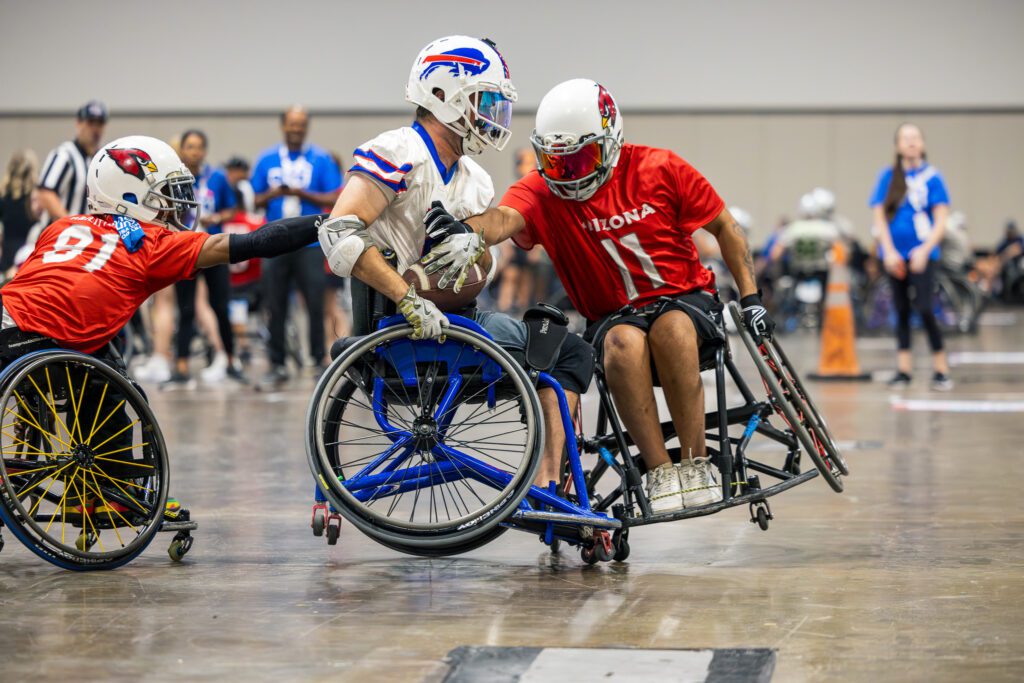
The USA Wheelchair Football League (USAWFL), operated by Move United and supported by NFL funding through the Bob Woodruff Foundation’s Salute to Service grants, is the premier national competition for adults with physical disabilities affecting the lower limbs. Founded in 2019 with just four teams, the USAWFL has grown to approximately 14 to 15 teams in NFL cities as of 2026 — including franchises affiliated with the Kansas City Chiefs, Tampa Bay Buccaneers, New England Patriots, Cleveland Browns, and Los Angeles Rams — with more than 850 athletes, coaches, and volunteers engaged since its launch.
Games are played on an indoor basketball court. Players are classified from 1 to 5 based on how their disability affects their ability to perform key football skills, ensuring competitive balance across teams. The ball is slightly modified for easier handling, traditional kicking is replaced with throwing, and sport wheelchairs are required for all players. The 2025 USAWFL Championship took place on November 22, 2025, with twelve teams competing — and the 3rd Annual USAWFL Veterans All-Star Game was held at NFL Draft Week in Pittsburgh in April 2026, cementing adaptive football’s visibility on the national stage.
Eligibility: A permanent physical disability affecting the lower limbs. Players must be able to wear a standard football helmet and breathe without mechanical assistance.
How to find a team: Visit moveunitedsport.org/usa-wheelchair-football-league/player-interest/ or contact Move United at (301) 217-9840.
Unified Flag Football (Special Olympics)
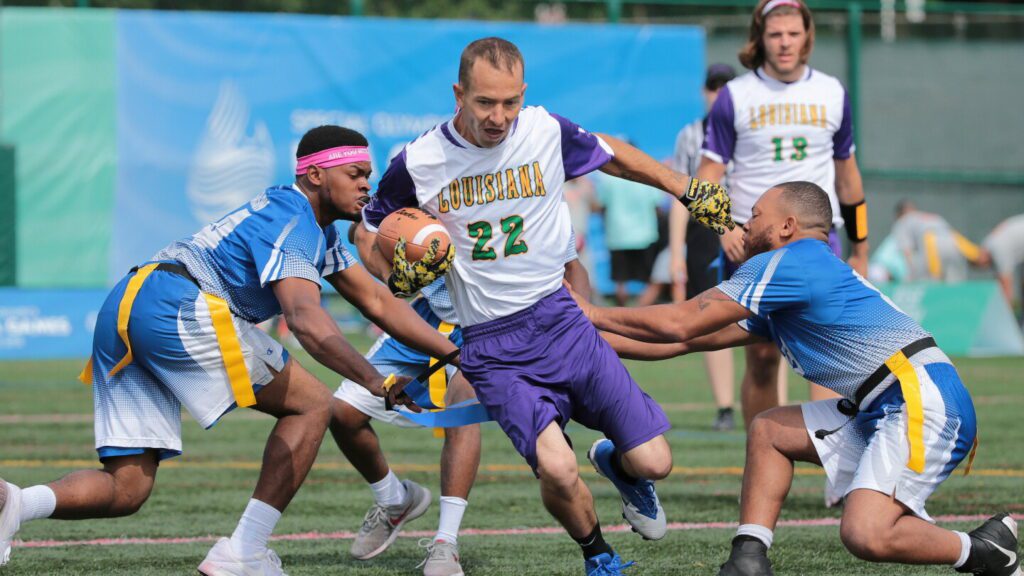
Special Olympics Unified Sports pairs athletes with intellectual disabilities and partners without intellectual disabilities on the same team — playing together, not against each other. The NFL Foundation has partnered with Special Olympics since 2017 through the NFL PLAY 60 initiative to bring Unified Flag Football to communities across the country, with an active pilot program in Colorado, Michigan, and Florida launched in 2024–2025.
The program’s reach is significant. The 2026 Special Olympics USA Games in Minnesota features Unified 5-on-5 flag football as an official sport, with approximately 38 teams and 350 athletes, partners, and coaches expected to compete. At the college level, the NIRSA and Special Olympics Unified Champion Schools framework has expanded flag football programming across campuses nationwide.
Eligibility: Athletes must have an intellectual disability to compete as athletes; individuals without intellectual disabilities are welcome as partners.
How to find a program: Visit specialolympics.org and search for your state chapter.
School-Based Wheelchair Football (AAASP)
The American Association of Adapted Sports Programs (AAASP) runs interscholastic adapted sports competitions for students with physical disabilities within school districts — meaning students compete against other school teams in a full athletic conference, just as any other student-athlete would. Wheelchair football is one of AAASP’s official sports, with programs operating in Georgia, Florida, Kentucky, and expanding states.
This is the high school-level counterpart to the USAWFL’s adult league, and for many young athletes, it is the gateway to a lifetime of adaptive sport.
How to find a program: Contact your school district’s special education or athletics department, or visit adaptedsports.org to see if AAASP operates in your state.
Youth Flag Football (Pop Warner Challenger Division and Beyond)
Pop Warner’s Challenger Division offers structured flag football for youth players with special needs, using modified rules designed to make the game inclusive and fun. In California, PlayLA runs adaptive flag football for youth ages 5–17 with physical disabilities. And Special Olympics Florida runs both Little ELITES (grades 2–5) and Rising Stars (grades 6–12) school-based programs that include flag football.
The People Who Are Changing the Game
Behind every stat is a person. Adaptive football’s story is told most powerfully through the athletes and coaches who have refused to let disability define the boundaries of their game.
Shaquem Griffin (shaquemgriffin.com) made history in 2018 when the Seattle Seahawks drafted him — making him the first player with an upper-limb physical disability to sign an NFL contract. Born with a condition that led to the amputation of his left hand at age 4, Griffin played linebacker for the Seahawks through 2020, later with the Miami Dolphins, and is now one of the disability community’s most visible advocates. He has partnered with Limbitless Solutions, a UCF-based nonprofit that creates low-cost 3D-printed prosthetics for children, and serves as a model of what is possible when the game is fully opened up.
Rob Mendez has never played a down of football — because he was born with tetra-amelia syndrome, meaning he has no arms or legs. That didn’t stop him from spending twelve years as a football assistant coach and becoming head JV coach at Prospect High School in Saratoga, California. At the 2019 ESPYS, ESPN awarded Mendez the Jimmy V Award for Perseverance. His motto: “Who says I can’t?”
Jake Olson (jakeolson.me) lost his eyesight to retinoblastoma (eye cancer) at age 12 and went on to become a long snapper for the USC Trojans football team — competing as a blind athlete at the college level.
These stories span generations and disabilities, but they carry a common message: the game has always made room for people willing to fight for their place in it. Adaptive football simply makes that room official.
Why Adaptive Football Matters: The Research Behind the Game
Participation in adaptive sports is not just about competition — it has measurable effects on health and quality of life. A 2023 meta-analysis found that adaptive sport participation showed consistent positive impacts on mental quality of life among adults with physical disabilities. A 2026 study published in Adapted Physical Activity Quarterly comparing 181 adults with physical disabilities found significant associations between adaptive sport participation and lower depression, lower anxiety, higher self-esteem, and stronger social skills. And a 2022 NIH study on veterans with disabilities found meaningful improvements in quality of life following adaptive sporting events.
Beyond the research, participants in qualitative studies consistently name community and belonging as among the most powerful outcomes of adaptive team sports — something football, with its emphasis on collective effort and shared identity, delivers in abundance.
Adaptive Football and Veterans: A Natural Partnership
The USAWFL was built in part with veterans in mind. The Bob Woodruff Foundation’s Salute to Service grant — funded through the NFL’s partnership — explicitly targets veteran participation in the league, and veterans make up a significant portion of USAWFL rosters nationwide.
For veterans with service-related disabilities, the path into adaptive football often runs through the VA system. The VA Adaptive Sports Program offers sports clinics and therapeutic programs at VA medical centers and in coordination with community partners. Veterans can ask their VA social worker or primary care team about the adaptive sports coordinator at their nearest VA medical center.
The DoD Military Adaptive Sports Program (MASP) provides reconditioning and competitive athletics for wounded, ill, and injured active-duty service members, with a goal of getting athletes into structured sport as early as possible in the recovery process. And the annual DoD Warrior Games — launched in 2010 — has driven enormous growth in adaptive sports infrastructure for veterans across the country.
How to Get Involved: A Step-by-Step Guide

Finding your way into adaptive football is more straightforward than most people expect.
Step 1: Identify the right format. Use the guide above to determine which program fits your disability, age, and goals. Wheelchair football, Unified flag football, school-based adapted sports, and youth flag programs each serve different populations.
Step 2: Find a local team or program. The NCHPAD Program Directory is the best single tool for locating adaptive sports programs by zip code. For the USAWFL specifically, the player interest page at moveunitedsport.org lists current teams and allows prospective players to register their interest. For Special Olympics, visit specialolympics.org and search your state chapter.
Step 3: Understand eligibility. For the USAWFL, a permanent physical disability affecting the lower limbs is required, and players are classified at their first season. For Special Olympics Unified programs, athletes must have an intellectual disability; partners may join without one. For school-based AAASP programs, students must be enrolled in a participating school district.
Step 4: Connect with funding support. Adaptive sports equipment and travel can be expensive. The Challenged Athletes Foundation awarded $6.55 million in 4,025 individual grants in 2025, with applications accepted in October and November each year, and individual grants reaching up to approximately $3,500. Move United also offers individual athlete grants of up to $500 through its organizational grant program. Veterans should inquire about the VA Adaptive Sports Grant Program, which has distributed millions of dollars annually to adaptive sports programs nationwide — with FY2025 funding authorized at up to $16 million (VA SPORTS-25).
Coaching and Building Programs
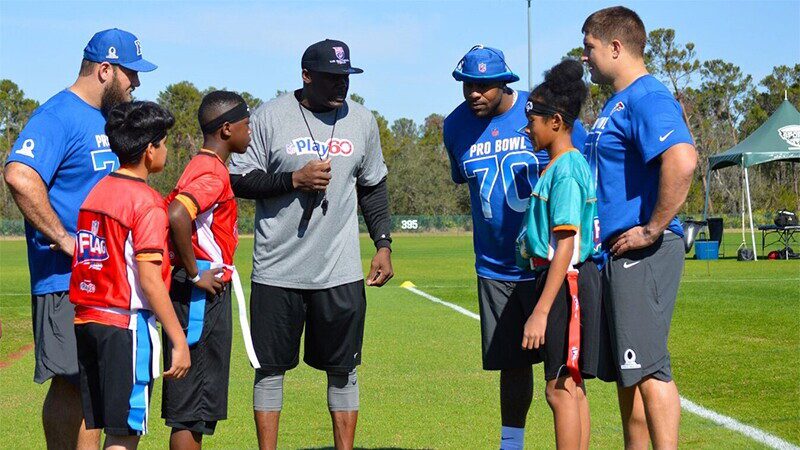
For coaches, educators, and administrators who want to bring adaptive football to their communities, two resources stand out. The NFHS “Coaching Adapted Sports” course — developed in partnership with AAASP — is an online, three-hour course approved for professional development credit that covers wheelchair handling, player safety, equipment use, and disability sport principles. The AAASP requires its own coaching education curriculum for all coaches in its interscholastic programs, including wheelchair football.
For youth program coordinators, NFL FLAG’s Unified Division pilot — launched in Colorado, Michigan, and Florida in 2024–2025 — offers a model for integrating players with and without disabilities at the recreational level, and may expand nationally in coming years.
What’s Next: The Future of Adaptive Football
The trajectory is clear: adaptive football is growing. The USAWFL has expanded from 4 teams in 2019 to roughly 15 teams in 2026, with the 2025 championship drawing twelve competing franchises. Flag football’s inclusion in the 2028 Los Angeles Olympics signals a new era for the sport’s visibility — and while no parallel adaptive track has been announced for LA 2028, advocates are already pushing for a Paralympic pathway. AAASP’s interscholastic programs continue to expand into new states, and Special Olympics USA Games are spotlighting Unified flag football on an ever-larger stage in 2026.
For anyone who has ever watched a football game and wondered whether the game could belong to them too — the answer, in 2026, is yes.
Frequently Asked Questions
Do I need prior football experience to join an adaptive league? No. Most adaptive football programs welcome beginners. The USAWFL, for example, accepts players at all skill levels and provides training through its affiliated teams. Contact the team in your city and ask about open tryouts or practice sessions.
Can people with upper-limb disabilities play wheelchair football? Yes. The USAWFL’s five-class classification system accounts for upper-limb function, and players with limited hand or arm use can still compete in lower classification tiers where rules are adjusted accordingly.
Is adaptive football safe? Like all contact sports, wheelchair football carries some risk of injury. Back and neck discomfort from extended sitting in sport chairs has been reported. Proper equipment fitting, working with a classification official, and communicating with your care team are all important steps before starting.
What if there is no team in my area? Contact Move United’s national office at (301) 217-9840 or complete the player interest form at moveunitedsport.org. Move United works to connect prospective players with the nearest existing team or, where interest is sufficient, to support the formation of new teams. Also search the NCHPAD Directory for local adaptive sports programs that may include flag football.
How is this different from Paralympic football? American-rules football does not currently have a Paralympic pathway — “football” in Paralympic competition refers to para soccer. The USAWFL is the closest thing to a national governing body for adaptive American-rules football, and advocates are working toward greater recognition. Special Olympics flag football competes in the Special Olympics USA Games structure.
Ready to Play? Here’s Where to Start
| Your Situation | Best Program | Where to Go |
| Adult with physical disability (lower limb) | USA Wheelchair Football League | moveunitedsport.org |
| Adult or youth with intellectual disability | Special Olympics Unified Flag Football | specialolympics.org |
| High school student with physical disability | AAASP Interscholastic Wheelchair Football | adaptedsports.org |
| Child with special needs (youth) | Pop Warner Challenger Division | popwarner.com |
| Veteran with service-related disability | VA Adaptive Sports / USAWFL | va.gov/adaptivesports |
| Not sure where to start | NCHPAD Program Directory | nchpad.org/Directories |
Need funding? Apply to the Challenged Athletes Foundation (applications open Oct–Nov annually, grants up to ~$3,500) or contact Move United about individual athlete grants up to $500.
Football season is here — and the field is wider than you think.
- Find your team: Use the NCHPAD Directory or the USAWFL player interest page to locate an adaptive football program near you.
- Share this article with a parent, coach, veteran, or therapist who might not know these programs exist.
- Support adaptive athletes: Donate to the Challenged Athletes Foundation or volunteer with your local Special Olympics chapter as a Unified Sports partner.
- Tell us your story: Are you playing adaptive football? Does your school or community have a program? Share it in the AmeriDisability community — your experience could change someone’s life.
AmeriDisability celebrates athletes of all abilities. Explore more sports content at AmeriDisability.com.
