Description
Disclosure — deciding whether and how to tell someone you have a disability — is one of the most frequent, fraught decisions adults with disabilities make. It’s not a one-time choice. It comes up at the doctor, at work, at family dinner, on a first date, on a job interview, in a Slack channel, in a social media post you might or might not publish, when a friend asks how you’re doing. Each context has different stakes. Each decision involves trade-offs. And the right answer isn’t the same for every person or every situation. This guide doesn’t tell you whether to disclose. That’s your call. What it does is help you think through disclosure decisions well — so the choices you make are the ones you actually want.
What’s Inside
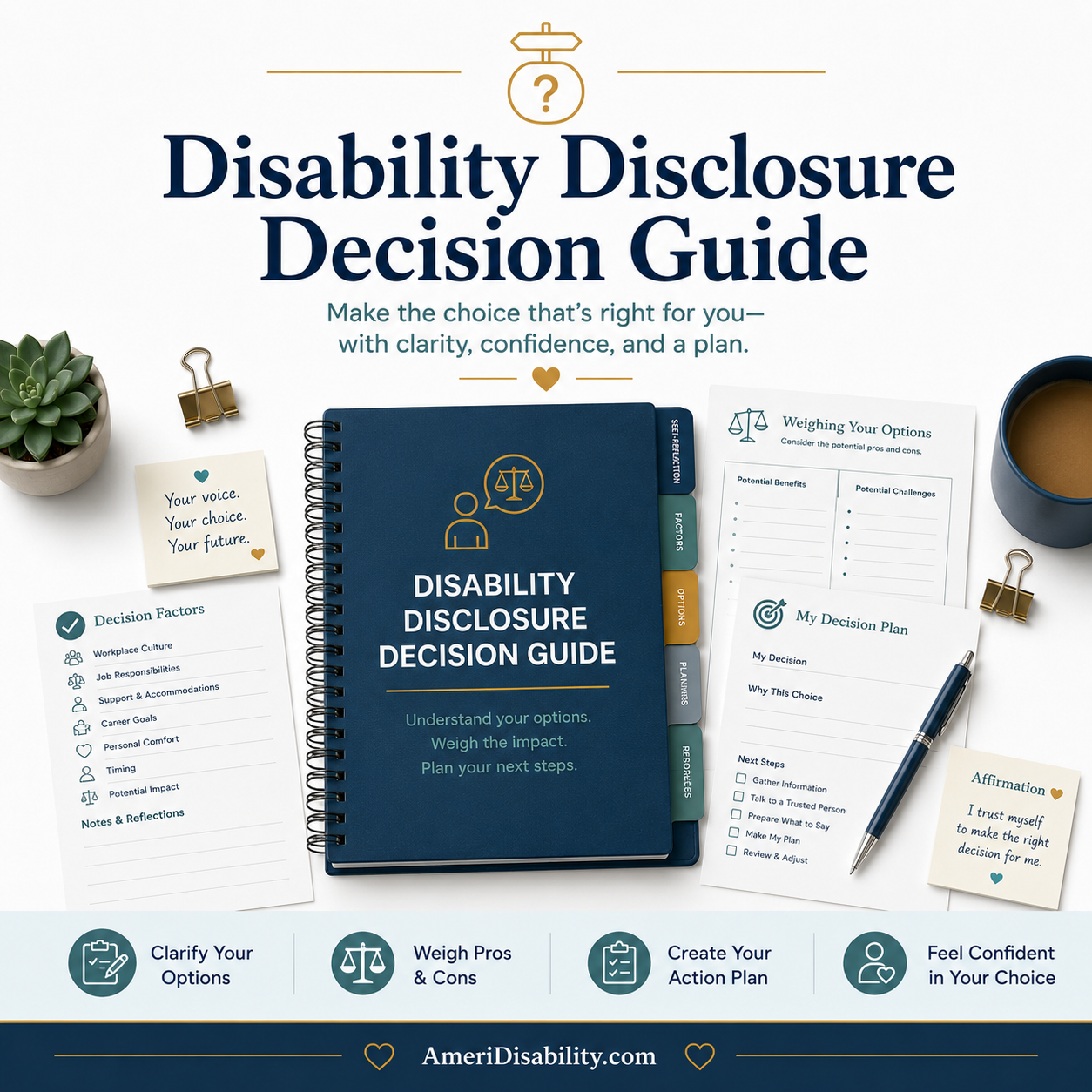
The Disability Disclosure Decision Guide is 40 pages organized into 11 sections:
- What Disclosure Actually Is — the disclosure spectrum, what counts as disclosure, the asymmetry (you can’t easily un-disclose)
- Why Disclosure Decisions Are Hard — the trade-offs, the energy cost, why there’s no universal right answer
- Your Relationship with Your Disability — self-knowledge worksheet that informs every disclosure decision
- Disclosure in Healthcare — when, how much, what stays in records, when healthcare disclosure feels hard
- Disclosure at Work (Beyond Formal Accommodations) — interviews, casual disclosure, industry and career stage considerations
- Disclosure with Family — close family, extended, in-laws, generational and cultural factors, planning worksheet for hard conversations
- Disclosure in Romantic Relationships — dating apps, first dates, early dating, established relationships, partners
- Disclosure with Friends and in Everyday Social Settings — close friendships, new friends, service interactions, public spaces
- Public Disclosure: Social Media and Advocacy — Twitter/Bluesky, Instagram, TikTok, LinkedIn, blogs — the permanence problem
- A Decision Framework You Can Use Anywhere — 7 questions to ask before any disclosure decision, with a fillable worksheet
- After Disclosure: Regret, Repair, and Disclosure Fatigue — what to do when it didn’t go well, when you wish you had, how to manage the ongoing weight
This Disability Disclosure Decision Guide Is For…
- Adults with disabilities making disclosure decisions for the first time
- Adults with disabilities who’ve been navigating disclosure for years and want a more deliberate framework
- Newly diagnosed adults figuring out what to share and with whom
- Adults with invisible disabilities who pass and are deciding whether to keep doing so
- Adults with visible disabilities deciding how much to volunteer beyond what’s obvious
- Adults preparing for a specific high-stakes disclosure (a parent, a partner, an employer)
- Adults recovering from a disclosure that didn’t go well
This guide assumes
- Your disclosure decisions are yours, not anyone else’s, including this guide’s
- Not disclosing is a legitimate choice in many situations
- Disclosing is also a legitimate choice in many situations
- Different people thrive at different points on the privacy-to-openness spectrum
- The same person may want different levels of disclosure in different contexts
- Decisions can change over time as your situation changes
- You’re capable of making good decisions when you have the relevant information
This Disability Disclosure Decision Guide Won’t Push You Toward Any Answer
Many disability resources push hard toward disclosure as if openness is always the healthier choice. The reality is more complex. Some people genuinely thrive being private. Some people genuinely thrive being out. Most people fall somewhere in between, with different positions in different contexts. This guide respects that. No pressure toward disclosure. No pressure toward non-disclosure. Just frameworks for thinking it through.
Companion to the Workplace Accommodation Request Workbook
If you’re navigating disclosure specifically for workplace accommodation requests, the Workplace Accommodation Request Workbook ($19) covers that process in depth — the legal framework, letter templates, retaliation protections, and what to do if your request is denied. This guide covers the broader disclosure question that runs through your whole life.
The Bottom Line
Disclosure is a tool, not a virtue. Use the level that serves your life. Change it when your life changes.
$15 — instant PDF download.