Description
Workplace performance reviews are often subjective. For employees with disabilities, that subjectivity intersects with bias, with assumptions about what “good performance” looks like, and with a recurring question that’s almost never asked out loud: did the employee underperform, or did the accommodation fail? Without data, that question gets answered by whoever has the most authority in the room. With data, the question gets answered by evidence. This tracker is the data layer underneath every performance conversation you’ll have at work — built around the realities of working with a disability, with templates you actually use.
What’s Inside
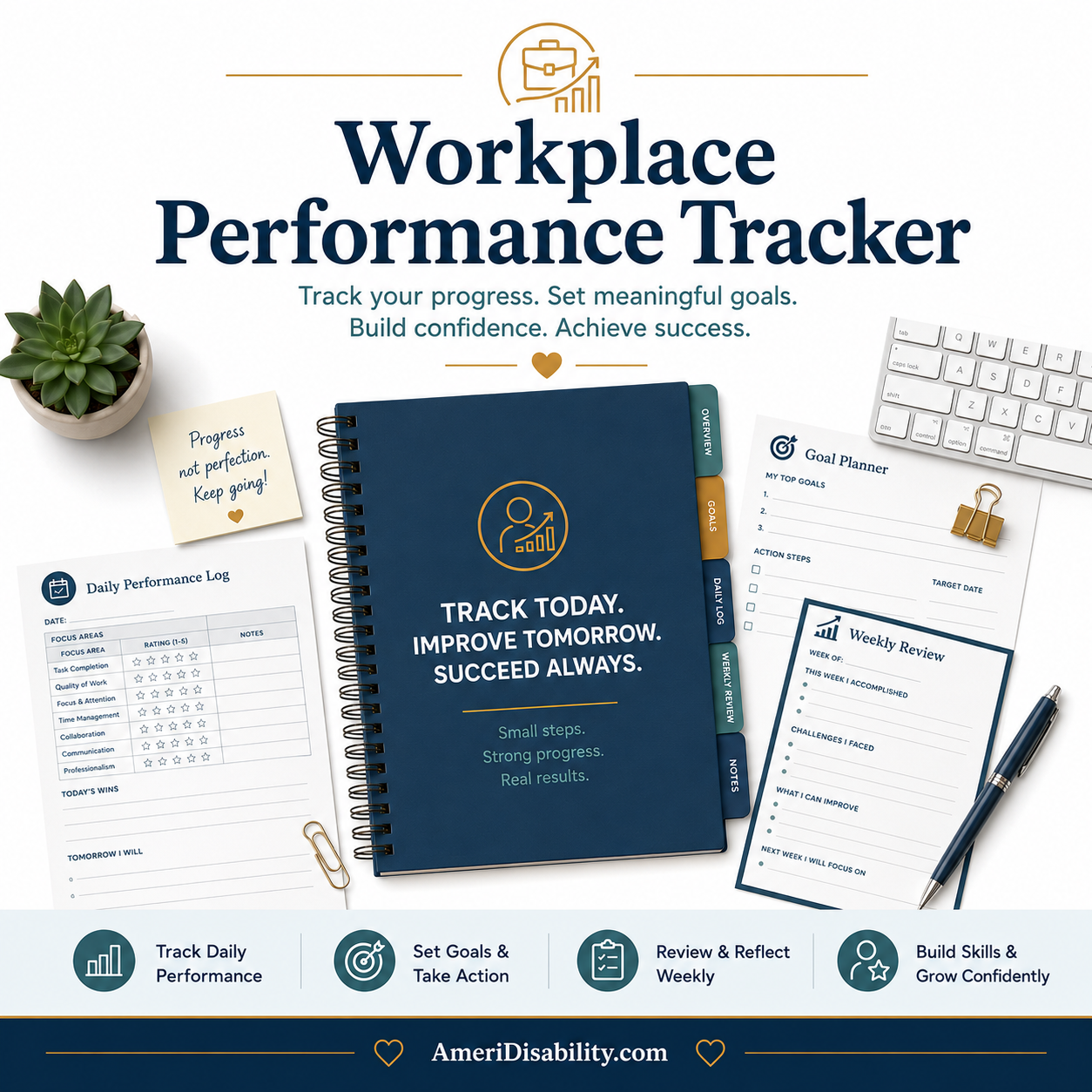
The Workplace Performance Tracker is 43 pages organized into 10 sections:
- About Tracking Your Work — brief framing on why systematic tracking matters for employees with disabilities, including the “did I underperform or did the accommodation fail” problem
- Daily / Weekly Capture Log — the core 5-minutes-a-week template, with multiple printable copies
- Accommodation Effectiveness Check-in — one per accommodation, used monthly or quarterly; catches problems before they become reviews
- Incidents and Pattern Log — for micro-aggressions, accommodation lapses, dismissive treatment, and anything else worth a record
- Wins and Accomplishments Log — easy to forget; recording them as they happen
- Monthly Summary Template — synthesize the week-by-week data into patterns
- Performance Review Prep Workbook — the multi-page synthesis you bring to the review meeting
- Responding to a Poor Review — when the review doesn’t match your data; includes a structured response template
- Building the Case for Advancement — promotion, raise, stretch assignments — using your tracker data
- Annual Review and Planning — year-end synthesis with next-year planning
This Workplace Performance Tracker Is For…
- Employees with disabilities who already have accommodations and want to know if they’re working
- Employees with disabilities preparing for upcoming performance reviews
- Employees with disabilities pursuing promotion, raises, or stretch assignments
- Employees with disabilities who’ve received unfair reviews and want to push back with data
- Employees with disabilities building a record before requesting accommodation adjustments
- Employees with disabilities documenting patterns of workplace incidents or accommodation lapses
- Newly accommodated employees establishing a baseline for evaluation
Heavy On Forms. Light On Narrative.
This is a working tool, not a book. Most pages are fillable templates you fill in over time. The narrative sections are brief by design. The product is designed to be used across an entire year — print extras of any template you’ll use repeatedly. The weekly capture log especially: you’ll want 52 of those.
Why Systematic Tracking Matters
- Subjective reviews are vulnerable to bias. Tracked data resists bias.
- You’ll forget what happened. Six months from now, last Tuesday’s win is gone. So is last Tuesday’s accommodation lapse. Capture as you go.
- Patterns become visible over time. One bad meeting isn’t a pattern. Twelve over six months is.
- Your accommodations may need to change. What worked in March may not work in October.
- Conversations about your work become specific. Specific examples carry more weight than general claims.
- Documentation matters if things go sideways. Should things escalate to HR or EEOC, contemporaneous records carry far more weight than reconstructed memories.
Workplace Performance Tracker Companion Products
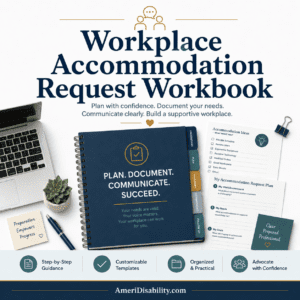
This tracker is the data layer; the Workplace Accommodation Request Workbook ($19) covers requesting accommodations in the first place; the Disability Disclosure Decision Guide ($15) covers whether to disclose.
The Bottom Line
Five minutes a day. One year of data. Your work, captured, ready for any conversation. $17 — instant PDF download.