


The holiday travel season is stressful for almost everyone — crowded terminals, packed flights, delayed connections, and the general chaos of moving millions of people across the country in a compressed window. For travelers with disabilities, the stakes are substantially higher. A damaged power wheelchair can cost tens of thousands of dollars and may be the only device that allows independent mobility. A missing service animal form can mean being denied boarding. An unstaffed wheelchair assistance desk can strand a traveler at the gate.
None of these scenarios are hypothetical. They happen every holiday season, and they are largely preventable — with the right preparation. This guide walks through every step, from booking to baggage claim, so you can travel on your terms this holiday season.
Your Rights as an Air Traveler with a Disability
The Air Carrier Access Act
The foundation of your rights in the air is the Air Carrier Access Act (ACAA), codified at 49 U.S.C. § 41705. Enacted in 1986 and significantly expanded since, the ACAA prohibits airlines from discriminating against passengers on the basis of disability. Its implementing regulations — 14 CFR Part 382 — set detailed requirements for how airlines must accommodate travelers with disabilities, covering everything from pre-boarding and seating to assistive device handling and in-flight service animal rules.
The ACAA applies to all flights operated by U.S. airlines, and to foreign airlines flying into or out of the United States.
DOT Wheelchair Rules: Where Things Stand in 2026

Wheelchair handling has been the most contested arena of disability air travel rights in recent years, and the regulatory landscape is in transition.
In December 2024, the U.S. Department of Transportation (DOT) issued a landmark final rule — formally titled “Ensuring Safe Accommodations for Air Travelers With Disabilities Using Wheelchairs” — that took effect on January 16, 2025. The rule created a presumption of airline liability for damaged or delayed wheelchairs and scooters: if your wheelchair is returned damaged, the burden shifts to the airline to prove the damage was pre-existing, caused by the passenger, or the result of a false claim. The rule also strengthened requirements for staff training and pre-departure notifications.
However, in August 2026, DOT issued a notice extending enforcement discretion for four specific provisions — the liability presumption, refresher training frequency requirements, pre-departure notification requirements, and fare difference reimbursement requirements — through April 30, 2027. A follow-on rulemaking (“Wheelchair Rule II”) is underway to formally address those paused provisions.
What this means for you today: The older framework still applies. If an airline damages your wheelchair or scooter, the airline is required to repair or replace it at the device’s full original purchase price. Airlines cannot cap their liability below that amount. That protection is in effect and enforceable. The airline staff who physically assist passengers with mobility also had a mandatory training deadline of June 17, 2026 under the December 2024 rule — meaning staff should have received enhanced training before this holiday season.
The Accessible Lavatory Rule
A separate August 2026 Federal Register notice also extended enforcement discretion on the flight attendant training mandate under DOT’s accessible lavatory rule, which applies to single-aisle aircraft. That rulemaking is ongoing. Travelers who require accessible lavatory accommodations should notify their airline at booking.
Step-by-Step: What to Do Before You Book
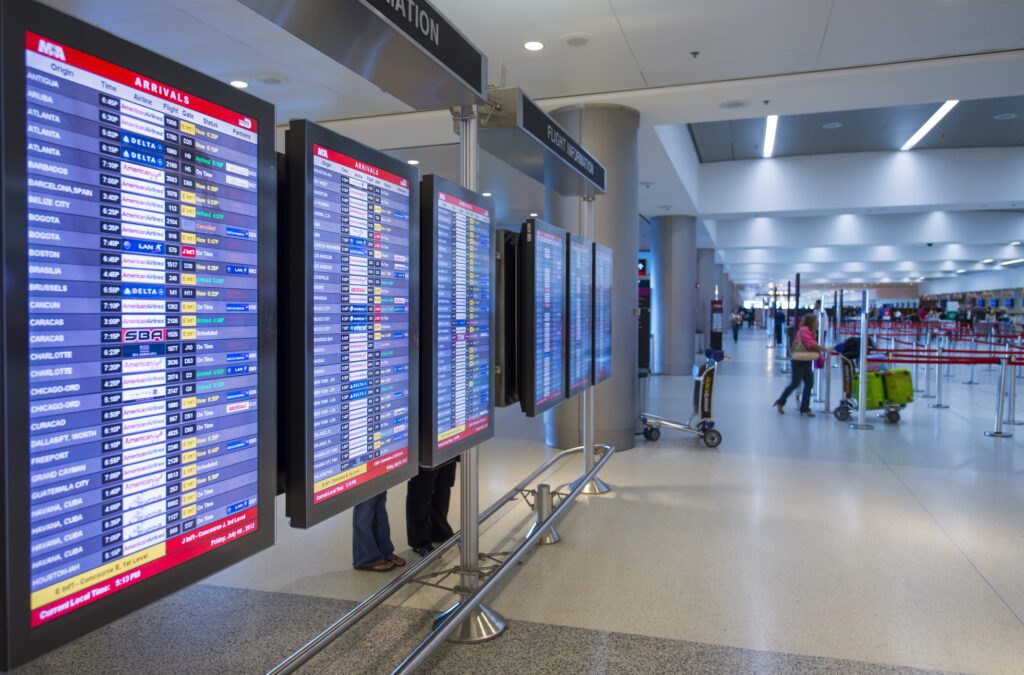
Being prepared before you purchase a ticket is the single most effective way to avoid problems during holiday travel. Here is a checklist.
1. Notify the Airline of Your Disability Needs at Booking
Do not wait until the airport. At the time of booking — whether online, by phone, or through a travel agent — disclose every accommodation you will need:
- Airport wheelchair assistance (from curb to gate, gate to gate, or gate to curb)
- Bulkhead or aisle seating with extra space or specific accessibility needs
- In-cabin wheelchair storage for a collapsible manual wheelchair
- Power wheelchair or scooter transport in the cargo hold
- Oxygen or other medical equipment
- Service animal travel
Under 14 CFR § 382.93, airlines are required to offer pre-boarding to passengers who self-identify as needing additional time or assistance to board, stow assistive devices, or be seated. That pre-boarding offer only works if the airline knows you are coming.
Call the airline’s dedicated accessibility desk directly, not the general reservations line. Major carriers maintain dedicated lines:
- American Airlines Special Assistance: 1-800-433-7300 (TTY 1-800-543-1586) — advise 48 hours before departure for assistive devices
- Delta Air Lines Special Assistance: accessible via delta.com or by calling 1-800-221-1212 — recommend notifying at booking; request pre-boarding and stowage space for in-cabin collapsible wheelchair
- United Airlines Accessibility Desk: 1-800-228-2744 — advise at least 48 hours in advance for assistive devices
2. Carry Documentation for Your Disability and Equipment
You are generally not required to prove your disability to fly. However, documentation is helpful in disputed situations and required for certain accommodations:
- Service animals: Airlines are permitted — and many now require — that you submit the U.S. DOT Service Animal Air Transportation Form (OMB Control Number 2105-0576, currently approved through September 30, 2027) before travel. Submit it at least 48 hours before departure. For flights over eight hours, some carriers also require a Service Animal Relief Attestation Form confirming the animal can relieve itself in a sanitary manner or will not need to relieve itself during the flight. Contact your airline to confirm which forms are required. Emotional support animals are not required to be accepted as service animals under current DOT rules — only trained service dogs qualify.
- Portable oxygen concentrators (POCs): You will generally need a letter from your physician stating your diagnosis, your in-flight oxygen requirement in liters per minute, and that you are fit to fly. The FAA must approve POCs for in-flight use, and each airline maintains a list of approved devices — verify yours is on the list.
- Power wheelchairs: Airlines will ask for the wheelchair’s battery type (lithium-ion, sealed lead acid, wet cell) to determine how it must be packaged and stowed. Have the wheelchair’s specifications sheet — including battery type, dimensions, and weight — available when you call.
3. Book Your Seat Carefully
Under the ACAA, airlines must provide specific seating accommodations without charge to passengers with disabilities who need them. These include bulkhead seats, seats with movable armrests, and seats in a row with extra leg room if the passenger’s disability requires it.
Book as early as possible. Holiday flights fill fast, and accessible seating is limited. If you are assigned a seat that doesn’t meet your needs and you requested an accessible seat at booking, escalate to the airline’s accessibility desk before you get to the airport.
At the Airport: What to Expect

TSA Screening
The Transportation Security Administration (TSA) has a dedicated program for travelers with disabilities: TSA Cares.
- TSA Cares Helpline: 1-855-787-2227 (TTY/TDD: 711)
- Hours: Monday through Friday, 9 a.m. to 9 p.m. Eastern time, excluding federal holidays
- Call at least 72 hours before departure to arrange a Passenger Support Specialist (PSS) to assist you through the checkpoint
A TSA Cares call does not exempt you from screening, and it does not provide expedited screening — that is TSA PreCheck, which travelers with disabilities can and should consider enrolling in if eligible. What TSA Cares does is ensure a trained specialist will be available to walk with you through the process.
You may disclose your disability or medical condition to TSA officers verbally, using a TSA Notification Card (available free at tsa.gov), or by providing written documentation. Officers are trained to work with travelers who have implanted devices, prosthetics, insulin pumps, ostomy bags, feeding tubes, and other medical equipment.
Key points for the security checkpoint: – Wheelchairs and scooters will go through X-ray screening or be manually inspected; you will not be separated from your device for longer than necessary – If you cannot walk through the metal detector or body scanner, you will receive a pat-down with an officer of the same gender (you may request this); a private screening area is available on request – You are not required to remove a brace, cast, or prosthetic limb — but it may require additional screening – Liquid medications and medical supplies (including larger-than-3-oz containers) are allowed through the checkpoint — declare them to officers and keep them separate from your other carry-on items
Pre-Boarding
Once you reach the gate, identify yourself to gate staff as a passenger who requires pre-boarding. Airlines are required by law to offer it; you do not need to show documentation. Gate agents have wide discretion over timing, so arrive early — especially at busy holiday gates — and do not wait until the final boarding call.
If your wheelchair is being checked at the gate, complete all documentation before stepping onto the jet bridge. Request a gate-check tag and confirm in writing (or by email to yourself) the condition of the wheelchair at time of handoff. Many experienced wheelchair users photograph their chair thoroughly before relinquishing it at the jet bridge.
On the Plane: Seating, Equipment, and Service Animal Rules
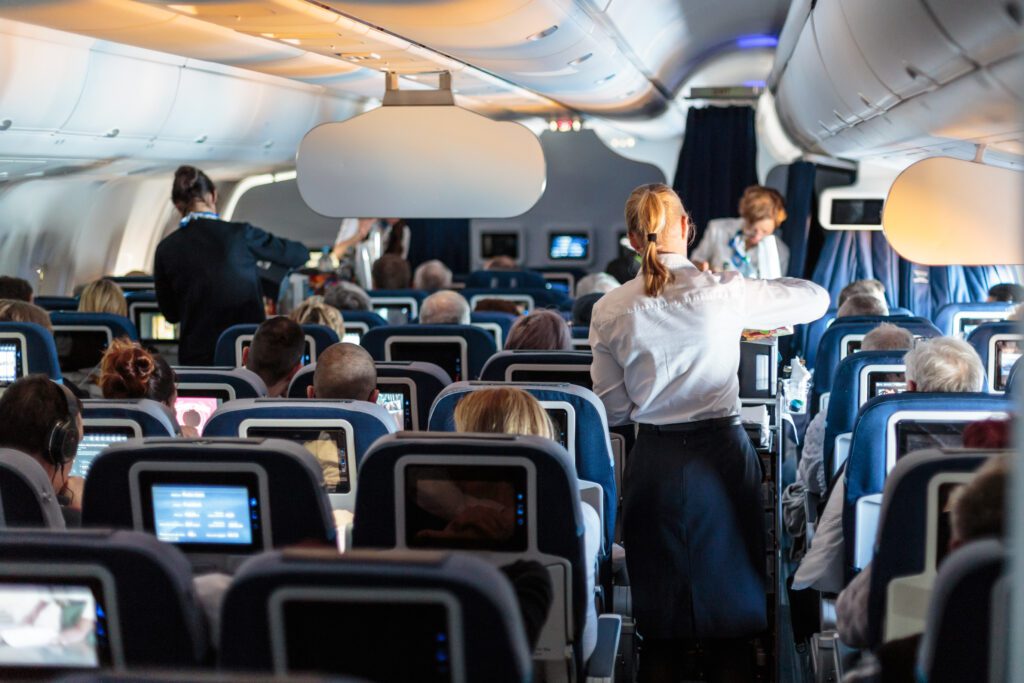
Seating Accommodations
Once on board, you have the right to:
- Sit in your reserved accessible seat — a passenger without a disability cannot be assigned your accessible seat in a way that displaces you
- Use an aisle chair to transfer from the jet bridge to your seat; request one when you notify the airline in advance
- Request assistance with stowing a carry-on bag in the overhead bin if you are unable to do so yourself
In-Cabin Wheelchair Storage
Each aircraft has space for one collapsible manual wheelchair in the cabin. That space is first-come, first-served among passengers who pre-board with a collapsible chair. This is another reason to pre-board: if you wait for general boarding and the in-cabin space is taken, your chair goes into the cargo hold.
Medical Equipment and Portable Oxygen
FAA-approved portable oxygen concentrators may be used on board. The airline must permit their use; some require pre-authorization and a physician’s statement. Request this accommodation at booking.
Service Animals
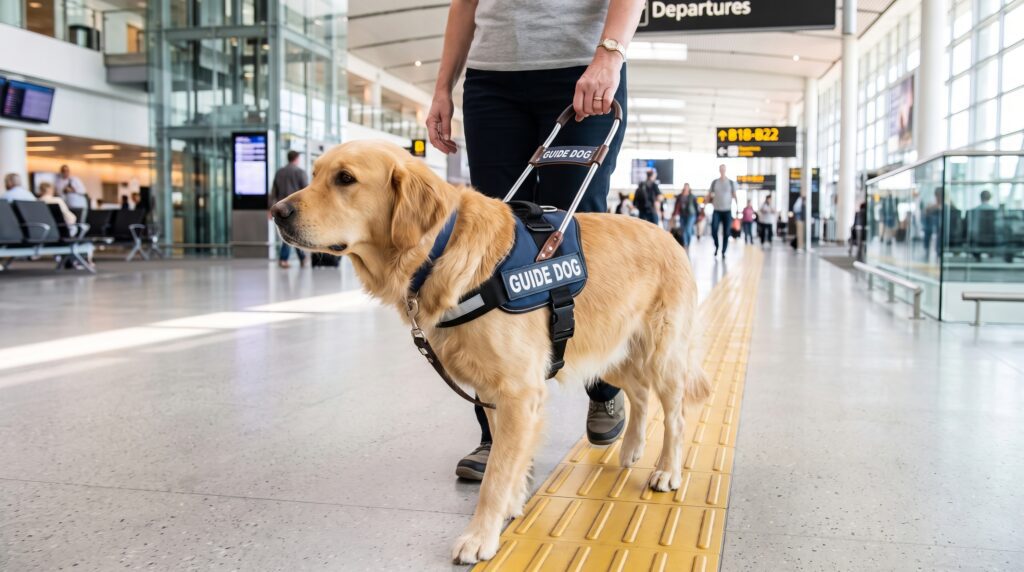
Under current DOT rules, only trained psychiatric service dogs and other service dogs qualify for in-cabin service animal status — emotional support animals are not covered. Your service dog:
- May occupy the floor space in front of your seat
- Must remain under control at all times and may not block the aisle or occupy a seat
- May be required to sit on your lap if small enough, or fit entirely in your floor space
If your service dog cannot fit in your floor space without blocking the aisle, the airline may move you to a bulkhead seat or the nearest available seat with adequate floor space — not remove your animal.
Wheelchair Users: Protecting Your Equipment
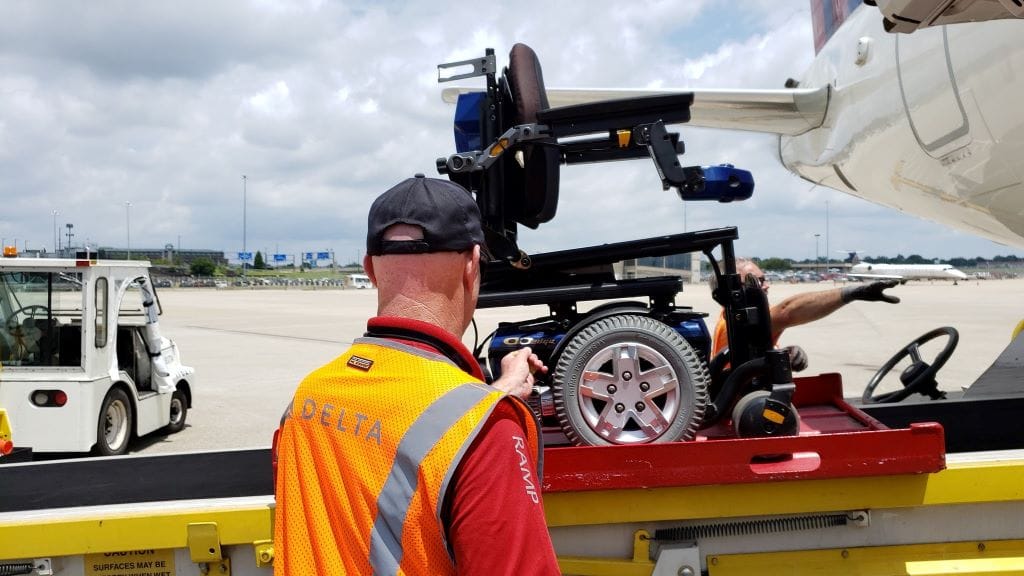
The Scale of the Problem
Wheelchair and scooter damage during airline travel is well-documented. According to DOT Air Travel Consumer Report data analyzed by WheelchairTravel.org, airlines mishandled approximately 1.26% of all wheelchairs and scooters transported in 2024, down slightly from 1.38% in 2023. At that rate, with hundreds of thousands of wheelchairs transported each year, thousands of devices are damaged or delayed during holiday travel alone.
The Paralyzed Veterans of America (PVA), which tracks this issue closely, reports that concerns about wheelchair damage remain one of the top reasons people with physical disabilities avoid flying. Complex rehab technology (CRT) power wheelchairs — the kind that serve as a person’s primary means of mobility — can cost $15,000 to $50,000 or more depending on the degree of customization, and damage during a holiday trip can leave a person stranded without their primary means of mobility for days or weeks.
Your Protections
Under the existing liability framework — which remains in effect regardless of the August 2026 enforcement pause — if an airline damages or loses your wheelchair or scooter, it must:
- Repair or replace the device at its full original purchase price — there is no liability cap
- Provide a loaner wheelchair while yours is being repaired or replaced, if one is available
- Reimburse reasonable expenses for renting a replacement device in the interim if no loaner is provided
Before You Fly: Protect Your Chair
- Photograph every angle of your wheelchair before you check it, including close-ups of any existing scratches or damage
- Carry your wheelchair’s make, model, and purchase price in writing
- Remove any detachable parts — joystick controllers, footrests, armrests — and pack them in your carry-on when possible
- Request that airline staff photograph the chair before they take it
- Remind the gate agent at the jet bridge that your chair should be returned to you at the jet bridge upon arrival, not the baggage claim — this is your right under federal regulations
At Baggage Claim
Inspect your wheelchair immediately upon return. If you notice damage:
- Do not leave the airport. Report the damage to the airline’s baggage service office before you exit
- File a written damage report with the airline on the spot — get a copy
- Photograph the damage immediately
- Contact the airline’s accessibility desk to begin the claims process
If Something Goes Wrong: Filing a Complaint

Violations of your ACAA rights are not simply customer service failures — they are federal civil rights violations. Here is how to escalate.
Step 1: Speak to the Complaint Resolution Official
Every airline is required by federal regulation to have a Complaint Resolution Official (CRO) available on request at every airport it serves. The CRO has authority to resolve disability-related issues on the spot. If you are denied pre-boarding, refused an accommodation, or told your service animal cannot board, ask immediately for the airline’s Complaint Resolution Official. The CRO must be available by phone at no cost to you if not physically present.
Step 2: File a Complaint with the Airline
Under the ACAA, you must file a written complaint with the airline within 45 days of the incident. The airline must:
- Acknowledge your complaint within 30 days
- Provide a substantive written response within 60 days
Keep copies of all correspondence.
Step 3: File a Complaint with the DOT
You can file a disability complaint with the DOT directly — you do not have to go to the airline first. File:
- Online: DOT Aviation Consumer Protection — File a Complaint
- Phone: DOT Disability Hotline: 1-800-778-4838 (TTY: 711)
- Mail:S. Department of Transportation, 1200 New Jersey Avenue SE, Washington, DC 20590
File your DOT complaint within six months of the incident. Include your full name, contact information, the airline, flight number, date, and a detailed description of what occurred.
DOT complaints are tracked and published in the monthly Air Travel Consumer Report. Airlines with high rates of disability complaints receive enforcement attention. Your complaint matters — both for your own case and for documenting systemic patterns.
From Our Shop
Ready to put these ideas into action? These printable guides can help.


What You Can Do
Your rights do not disappear when you buy a ticket. If you are planning holiday air travel and have a disability, start your preparation now — before the most congested travel days of the year. Notify your airline, call TSA Cares, photograph your equipment, and carry this guide with you.
Share this article with a family member or caregiver who will be traveling with you. And if you experience a problem during your holiday travels, do not let it go unreported — file with your airline and with DOT. Every complaint on record helps build the case for stronger protections.
Disclaimer: This article reflects regulations and policies current as of November 2026. Airline-specific policies are subject to change; verify details directly with your carrier before travel. For regulatory updates, visit transportation.gov/airconsumer.
AmeriDisability.com is an independent disability news and lifestyle publication. This article is for informational purposes only and does not constitute legal advice.
If You Liked This Article, You May Also Like
- Best Adaptive Home Products 2026 — Tools and technology for independent living year-round
- Federal Policy and Americans with Disabilities in 2026: What Has Changed, What Is at Stake, and What the Data Show — The full policy picture affecting disability rights this year
- No Driver, No Problem: How Waymo’s Driverless Robotaxis are Opening New Roads for People with Disabilities — Autonomous transportation benefits the disability community
AmeriDisability.com is your source for disability news, advocacy, lifestyle, and community. Subscribe to our newsletter to receive new articles directly in your inbox.
