Description
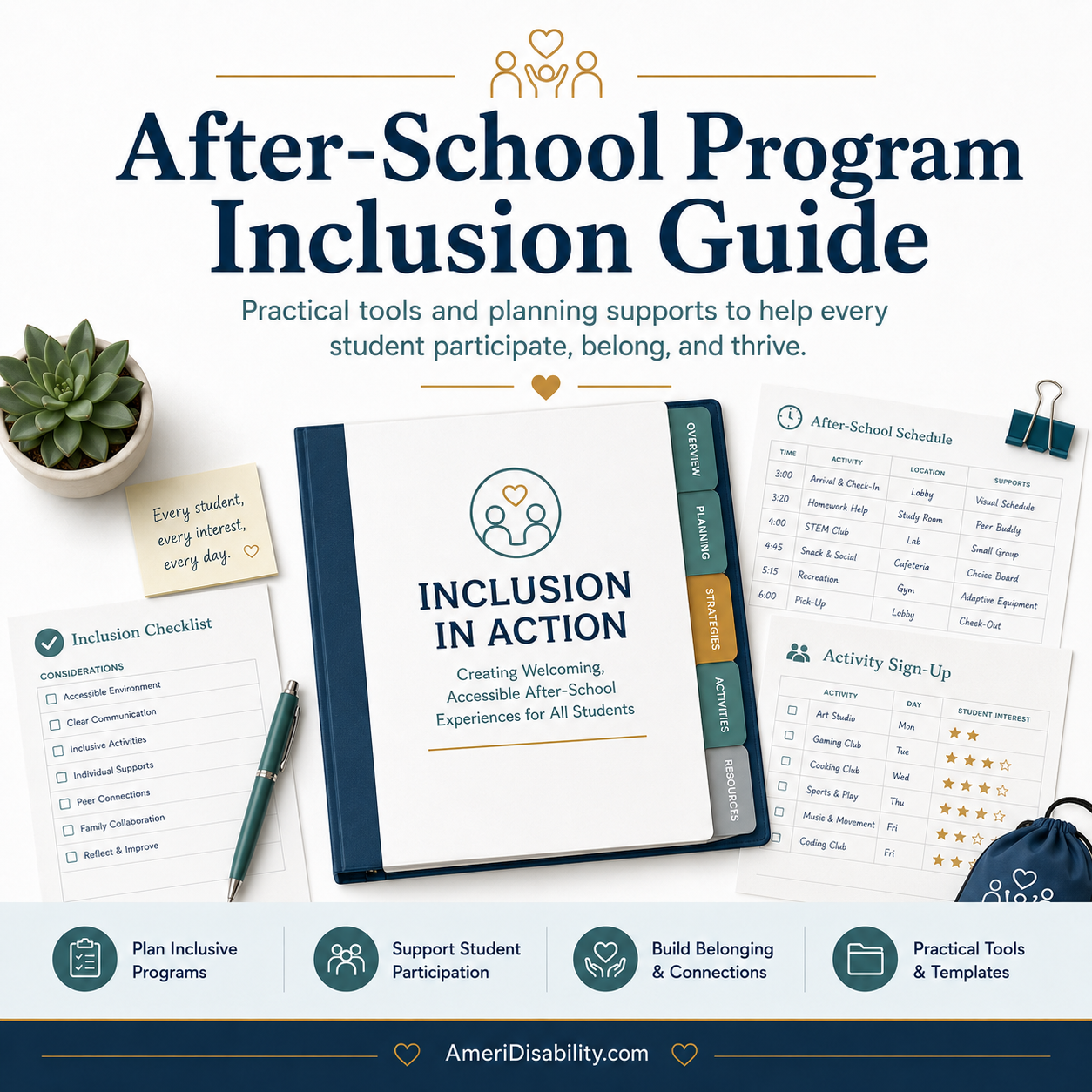
Kids with disabilities spend six hours a day in school. The other ten hours of their waking life happen outside it — including after-school programs, weekends, summers, and evenings. The people working with them in those hours often have a fraction of the training, none of the IEP information, and a fundamentally different role: this is supposed to be the fun part of the day, not more school. This After-School Program Inclusion Guide gives non-specialist program staff what they need to include kids with disabilities well — practically, respectfully, without pretending to be teachers or therapists.
What’s Inside
The After-School Program Inclusion Guide is 39 pages organized into 12 sections:
- Why inclusion matters in after-school programs — brief framing
- What’s different about after-school inclusion — no IEPs, voluntary, fun-focused, mixed-age, less trained staff
- Welcoming families — registration signals, the intake conversation, what to ask without being intrusive
- Ongoing communication with families — routine touchpoints, how to share concerns
- Reasonable accommodations without IEPs — what you can do, plus universal design strategies
- Behavior support in non-academic settings — reading behavior as communication, proactive strategies, in-the-moment response
- Sensory considerations — gyms, pools, outdoor, art rooms, music, drama, field trips — each with specific helpful strategies
- Activity adaptations — sports, art/music/creative, group games
- Safety planning — elopement, medical emergencies, allergies, water safety, plus a fillable Individual Safety Plan template
- Staff training basics — what every staff member should know, with a 60-minute training agenda
- Building inclusive program culture — peer relationships, language, belonging, addressing exclusion
- When you can’t accommodate — the questions to ask before concluding, the honest conversation if needed, legal protections to know about
This After-School Program Inclusion Guide Is For…
- After-school program directors, coordinators, and staff
- Summer day camp and overnight camp leaders
- Sports coaches and recreation leaders
- Art class, music class, and dance instructors
- Robotics, STEM, and academic enrichment program staff
- Scout leaders and faith community youth leaders
- Drama, debate, and other club advisors
- YMCA, Boys & Girls Club, and community center program staff
- Childcare providers and family-care programs
The After-School Program Inclusion Guide Is Written For Non-Specialists
This guide assumes you care about including kids with disabilities and want to do it well. It doesn’t assume you have special education training — and doesn’t require it. The skills you need are different from classroom teaching skills. The strategies, templates, and conversations in this guide are designed for the realities of after-school programs: limited budgets, limited time, high staff turnover, no formal disability documentation.
Acknowledges the realities
- No IEPs or 504 plans available to you
- Voluntary participation (kids and families can leave)
- Fun-focused, not learning-focused
- Mixed-age groups
- Different settings (gyms, pools, outdoor) with different sensory profiles
- Often part-time or seasonal staff
- High turnover, frequent retraining
The strategies work in those realities.
The Bottom Line
Kids with disabilities deserve great after-school programs. Programs deserve the tools to include them well. The difference between programs that include well and programs that exclude (or merely tolerate) is usually not money or expertise — it’s intentional practice. $19 — instant PDF download.