Description
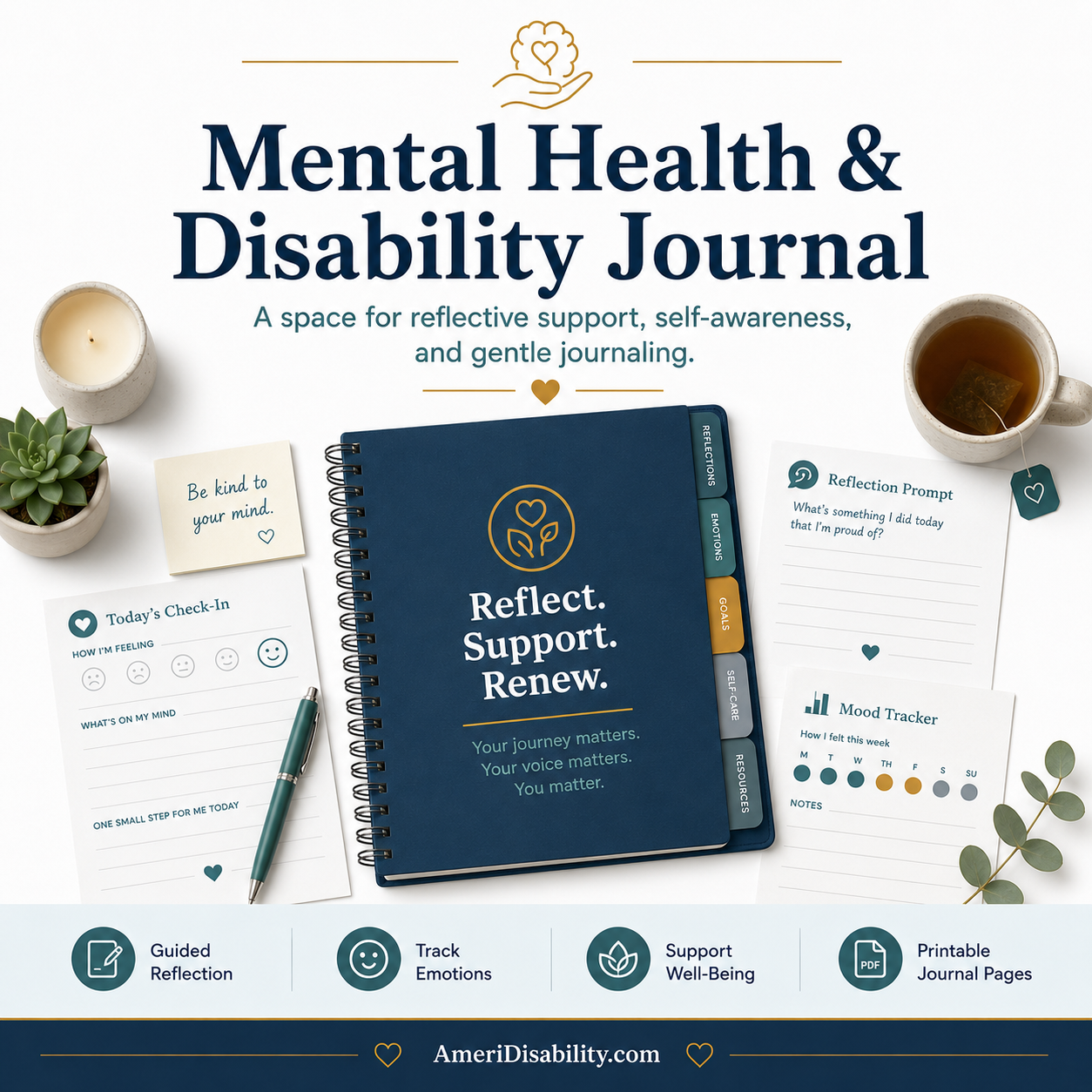
A 12-week guided journal that meets you where disability and mental health intersect. 45 pages. Energy-aware. No toxic positivity.
Most mental health journals assume you can exercise, sleep well, eat anything, and access support easily. For readers with disabilities, that gap can feel isolating — like the resources aren’t really for you. This journal centers disability and chronic illness in mental health support, with prompts that respect your reality and your strengths. Weekly (not daily) check-ins. Permission throughout to skip, rest, and return. Includes verified crisis resources for when journaling isn’t enough.
What’s Inside
The Mental Health & Disability Journal is 45 pages organized into 10 sections:
- Why This Journal Exists — the gap that mainstream content leaves, what this journal does differently, how to use it, what it isn’t
- Week 1: Where You Are Now — settling in, naming your starting point, what kind of support you have and wish you had
- Weeks 2-3: Noticing Your Day — two weeks of light noticing. Patterns, not problem-solving
- Week 4: What Fills Your Cup — real sources of energy, joy, replenishment (the things that fill you don’t have to be respectable)
- Weeks 5-6: What Drains You — honest naming, distinguishing what you can modify from what you can’t, coping with the unmodifiable
- Week 7: Identity & Belonging — disability as identity, your relationship with your body, what you’ve learned from living with your condition
- Weeks 8-9: Community & Connection — what kind of connection works for your reality, where to find disability community, what makes connection harder than you’d want
- Week 10: Hard Days — what hard days look like, what tends to come before them, what actually helps vs. what doesn’t, what to remember for next time
- Weeks 11-12: Looking Forward — what you’ve noticed across the weeks, what you want to carry forward, end-of-journal reflection
- Crisis Resources — verified national lines (988, Crisis Text Line, Trevor Project, SAMHSA, NAMI, National Alliance for Eating Disorders), beyond national lines (local crisis services, warm lines, culturally-specific resources), ongoing mental health support, with verification reminders
This Mental Health & Disability Journal Is For…
- Adults with disabilities navigating mental health
- People managing chronic illness alongside depression, anxiety, or other mental health concerns
- People who feel left out by mainstream mental health and wellness content
- Newly diagnosed adults processing identity change and grief
- Adults with long-term disabilities wanting space to reflect on what helps
- People between therapy sessions, or without therapy access, looking for a structured weekly practice
- Caregivers who want their own space for processing
What This Mental Health & Disability Journal Isn’t
Honest, up front:
- Not therapy. Journaling is not psychotherapy or psychiatric care. If you’re navigating significant mental health concerns, working with a licensed professional remains important. This journal supports that work; it doesn’t replace it.
- Not medical or psychological advice. Prompts are for reflection. Not diagnostic. Not treatment plans.
- Not a productivity tool or transformation program. 12 weeks of journaling won’t fix anything that needs fixing. The point is reflection, awareness, and noticing.
- Not a discipline test. Skip days, weeks, longer. The journal still works when you return.
- Not for crisis moments. If you’re in crisis, Section 10 has crisis resources. Reach for those, or call/text 988, or get to local emergency services.
What Makes This Mental Health & Disability Journal Different
- Assumes limited energy — weekly check-ins, not daily; short prompts; permission to skip; three words is a valid answer
- Centers disability as identity — not as obstacle to overcome, not as inspiration story
- Names structural barriers honestly — therapy isn’t always accessible, insurance doesn’t always cover what you need, community isn’t always reachable
- No toxic positivity — no “just think positive,” no mindset-is-everything, no pretending hard things aren’t hard
- Doesn’t push specific practices — some advice in mental health spaces actively doesn’t work for some bodies. The journal asks what works for YOU rather than prescribing universal techniques
- Includes real crisis resources — when journaling isn’t enough, Section 10 has verified national lines and ongoing support options
- New PERMISSION callouts throughout — explicit permission to skip, rest, feel angry, not “work on” yourself
Part of the Health & Wellness Bundle
The Mental Health & Disability Journal is part of the Health & Wellness Bundle ($59), which gathers AmeriDisability resources for people managing chronic conditions and mental health. The bundle is anchored by the Chronic Illness Symptom & Flare Tracker.
The Bottom Line
Support that fits your reality. 12 weeks — or 12 months. Or a few entries. Whatever you wrote, whatever you skipped, whatever you carried forward — this was your work.
$17 — instant PDF download. 45 pages.